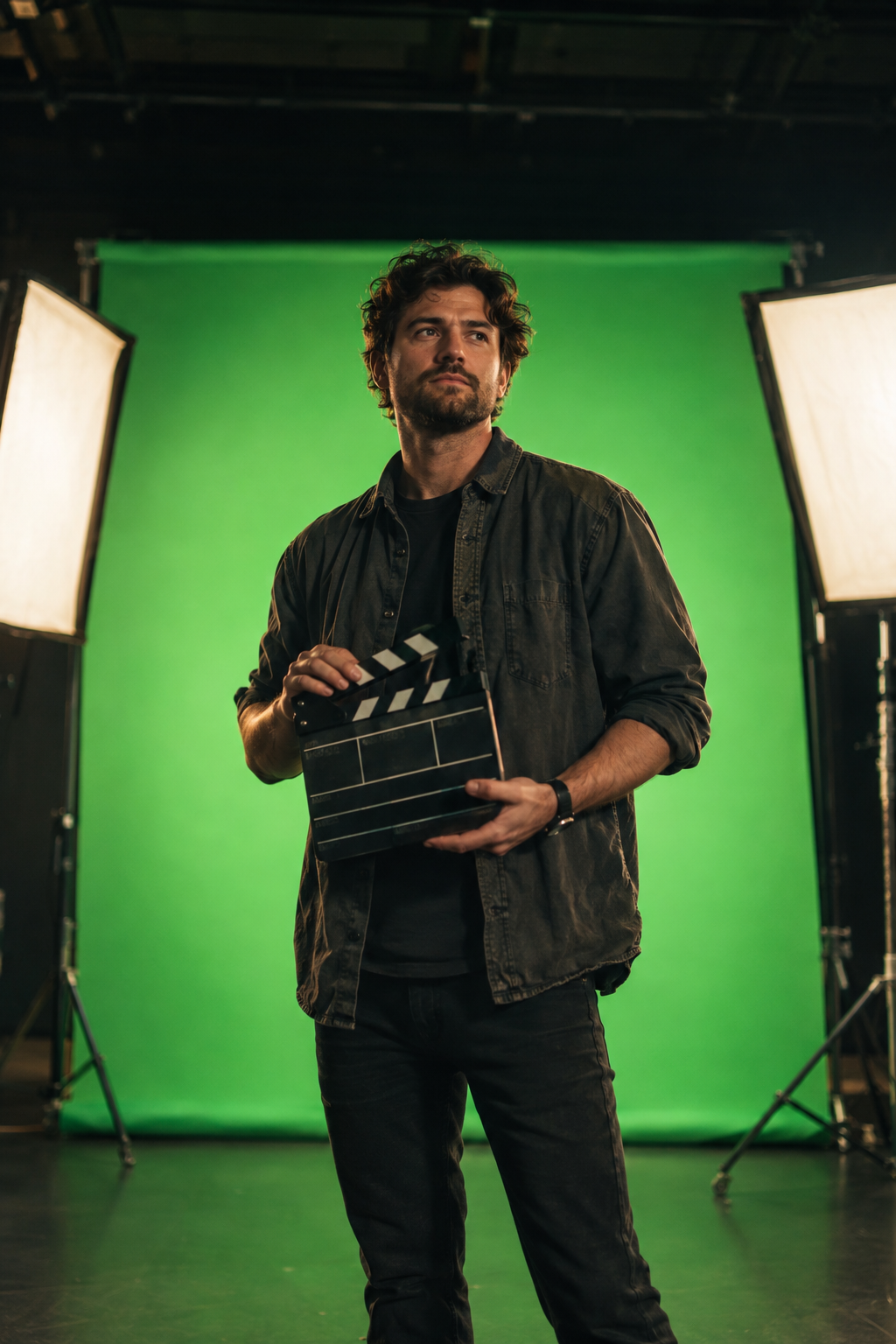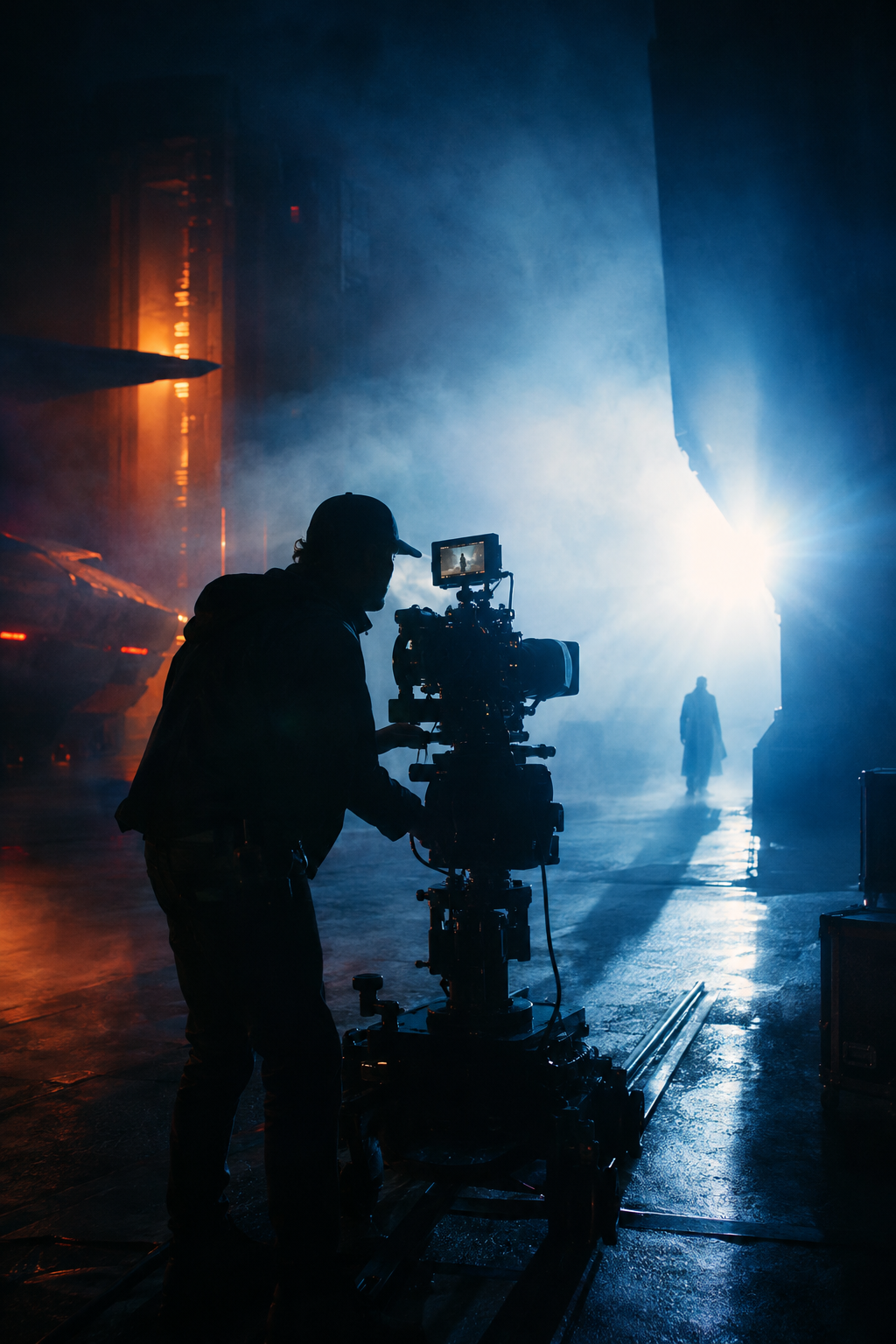
Greig Fraser shot the Giedi Prime arena sequence in Dune: Part Two (2024) with infrared cameras, which is why the Harkonnen sun looks like a black-and-white x-ray with skin glowing like bone. That one decision tells you most of what sci fi cinematography actually is: a set of choices about light, lenses, color and movement that convince you a place you have never seen is real. This piece walks through the techniques the best science fiction films use, who pioneered them, and which titles to study.
Key Takeaways
– Lighting does the heaviest lifting in science fiction film. A single hard source (2001, Blade Runner 2049) reads as “alien” far faster than any set.
– Three looks dominate the genre: neo-noir, grounded naturalism, and clinical paranoia. Most sci-fi films pick one and commit.
– Color rules, not color grades, define the strongest palettes. Her banned blue; The Matrix tinted its simulation green.
– Lens and format decisions (anamorphic, IMAX, infrared, film-out) are now as expressive as the story itself.
– Practical scale, motion control and LED volumes each solved a different problem across six decades.
1. Lighting: one hard source beats a hundred soft ones
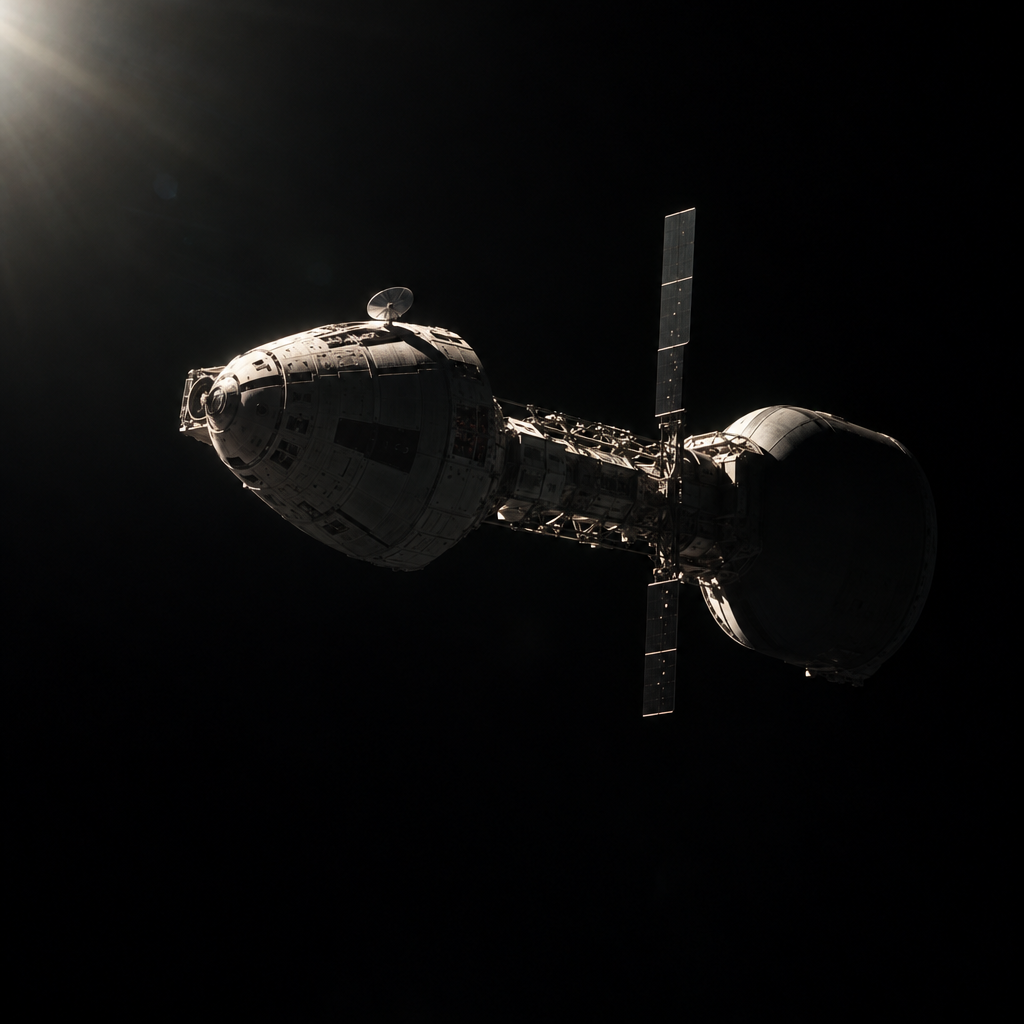
Stanley Kubrick’s 2001: A Space Odyssey (1968) still looks modern because Geoffrey Unsworth lit space the way space is actually lit. One sun, no fill, hard shadows that fall off into nothing. Every spaceship since has been chasing that logic.
Ridley Scott flipped it for Alien (1979). Derek Vanlint lit the Nostromo almost entirely with practicals built into the set: strip lights, console glow, the strobing emergency lamps in the self-destruct sequence. You never see a movie light, so the ship feels like a working vessel rather than a stage.
Roger Deakins pushed the single-source idea to its limit on Blade Runner 2049 (2017), which won him his first Academy Award for cinematography. Niander Wallace’s office is lit by a rippling water reflection bounced off a moving rig, and the Las Vegas sequence is basically one enormous orange sun filtered through dust. Deakins has said for years that he prefers to “sculpt” with one source rather than flatten a scene with many, and 2049 is the clearest demonstration of that philosophy in the genre.
Then there is the opposite approach. Bradford Young shot Arrival (2016) under soft, overcast, mostly available light, with the inside of the alien shell lit by a single wall of white. The result is a science fiction film that feels like a memory rather than a spectacle, which is exactly what the story needed.
What to take from this: before any camera or lens decision, ask where the light would come from in this world. Hard sun for space, practicals for ships, soft daylight for stories about people.
2. The three looks that keep coming back
Watch enough sci-fi and you start spotting the same three visual languages. They are not rules, but they are the defaults most directors and cinematographers reach for.
Neo-noir: Blade Runner and its descendants
Jordan Cronenweth’s work on Blade Runner (1982) built the template: smoke in every room, backlight cutting through it, Venetian blind shadows across faces, and rain to make every surface reflect neon. Scott shot it anamorphic so the flares streaked horizontally across the frame.
Almost every “cyberpunk” image since borrows from this, from Ghost in the Shell (1995) to the Netflix series Altered Carbon (2018). Blade Runner 2049 is the only follow-up that genuinely evolved the look, trading Cronenweth’s clutter for Deakins’ vast, empty color fields.
Grounded naturalism: Children of Men, District 9, After Earth
Emmanuel Lubezki shot Children of Men (2006) handheld with long takes and natural light, and the famous car ambush was filmed inside a modified vehicle with a rig that let the camera travel between seats. Nothing about the future looks designed, which is why it looks real.
Neill Blomkamp went further with District 9 (2009), using news-camera zooms and documentary framing. Even M. Night Shyamalan’s After Earth (2013), whatever its other problems, used Peter Suschitzky’s muted, forest-green palette to keep a far-future Earth looking like somewhere you could actually walk.
Paranoia and the clinical frame: Prometheus, Ex Machina, Under the Skin
The third look is cold, symmetrical and lit from above or behind glass. Dariusz Wolski shot Prometheus (2012) with Red Epic cameras in native 3D, and the engineer ship interiors are all hard blue-white edges and black voids. Fight Club is not science fiction, but its David Fincher coldness is a direct ancestor of this style.
Rob Hardy’s Ex Machina (2014) is the purest example. Nathan’s house was shot largely at the Juvet Landscape Hotel in Norway, and Hardy mixed warm interior tungsten with glacial exterior daylight so you always feel the glass between people. Daniel Landin shot Under the Skin (2013) in Glasgow with hidden cameras and non-actors, then dropped Scarlett Johansson’s alien into a pure black void lit by nothing at all.
3. Color: set a rule, not a grade
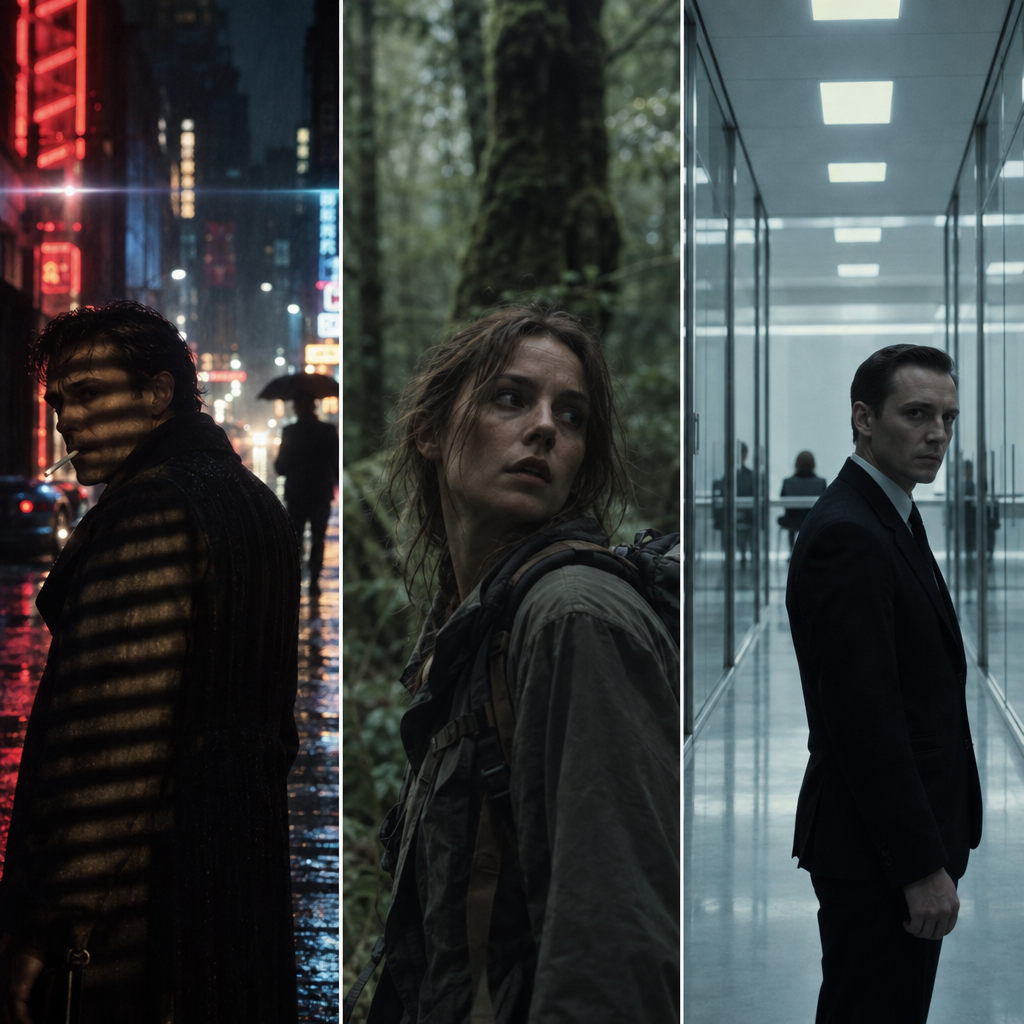
The weakest sci-fi films slap on teal and orange and call it a look. The strongest ones set a rule and build the whole image around it.
Spike Jonze and cinematographer Hoyte van Hoytema banned blue from Her (2013). Every frame leans warm, coral and cream, which is why that near-future Los Angeles feels gentle rather than threatening.
Bill Pope gave The Matrix (1999) its famous green tint for scenes inside the simulation and a cooler, bluer cast for the real world, so you always know where you are without a title card. The Wachowskis and Pope were explicit that the green came from the look of old monochrome monitors.
John Seale’s Mad Max: Fury Road (2015) went saturated and center-framed, and the night sequences were shot in daylight and graded a deep blue rather than lit for dark. Seale has said George Miller wanted every important element dead center so viewers could keep up with the cutting.
Andrei Tarkovsky’s Stalker (1979), shot by Alexander Knyazhinsky after two earlier cinematographers were replaced, uses sepia for the outside world and full color only inside the Zone. It remains the cleanest example of color as a narrative switch, and almost every “two worlds” sci-fi film since owes it something.
Fraser’s Dune (2021) is the modern case study. The Arrakis exteriors were shot in Jordan and Abu Dhabi, then the whole digital negative was printed to 35mm film and rescanned. That film-out step gave the sand its grain and dulled the highlights, which is a big part of why the movie looks older and heavier than most digital productions.
4. Lenses and formats are now part of the story
For most of the twentieth century a sci-fi cinematographer chose between spherical and anamorphic lenses and then got on with it. Today the format decision can be the headline.
Anamorphic glass gives you oval bokeh, horizontal flares and a 2.39:1 frame. Dan Mindel leaned into it so hard on J.J. Abrams’ Star Trek (2009) that the lens flares became a meme, but the choice worked. The Enterprise felt bright, busy and alive in a way the franchise had never been.
IMAX is Christopher Nolan’s instrument. Van Hoytema shot roughly an hour of Interstellar (2014) on 15-perf 70mm IMAX film, and the aspect ratio physically opens up from 2.39:1 to 1.43:1 when the picture cuts to the big-format footage. If you have only seen it at home you have seen a compromise.
Infrared has become a recent signature. Van Hoytema rigged infrared cameras alongside his IMAX cameras on Nope (2022) to shoot night scenes in daylight, and Fraser used infrared-modified Alexa cameras for the Giedi Prime sequence in Dune: Part Two. In both cases the technology exists to make something look wrong in a specific, controllable way.
Small cameras are the newest wrinkle. Gareth Edwards shot The Creator (2023) with Oren Soffer and Greig Fraser mostly on the Sony FX3, a camera that costs under $4,000, then added anamorphic lenses and heavy visual effects. The film reportedly cost around $80 million and looks like it cost three times that, which has made it a reference point for every producer trying to stretch a budget.
5. Movement and scale: how big should the camera feel?
Denis Villeneuve’s films move slowly on purpose. Fraser and Deakins both keep the camera mostly still, let characters walk into enormous negative space, and use scale references (a tiny figure against a sandworm, a car against the Vegas statues) rather than fast cutting to tell you something is huge.
Alfonso Cuarón takes the opposite view. Gravity (2013) opens with a shot that runs more than twelve minutes, and Lubezki and Framestore built an LED “light box” so the reflections on Sandra Bullock’s helmet and suit matched the digital Earth rotating outside. The camera never stops, which is how the film keeps you nauseous and terrified for ninety minutes.
James Cameron splits the difference. Aliens (1986), shot by Adrian Biddle, uses handheld only when the marines panic and locks the camera down for the colony’s empty corridors. Pay attention and you can predict an attack from the moment the frame starts to shake.
The lesson for anyone studying sci fi cinematography is simple. Movement should answer a question about the character’s state, not the budget’s.
6. Practical scale, motion control and the LED volume
Three technologies changed what science fiction could show, and each one is tied to a specific film and year.
Fritz Lang’s Metropolis (1927) used the Schüfftan process, a mirror trick that let Karl Freund and Günther Rittau photograph actors against miniature skylines. Douglas Trumbull’s slit-scan rig built the Star Gate sequence for 2001 in 1968, exposing one sliver of film at a time over hours.
John Dykstra’s Dykstraflex, a computer-controlled motion control camera built for Star Wars (1977), let ILM repeat exactly the same camera move over miniatures so multiple elements could be composited in one pass. Every dogfight in the original trilogy depends on it.
The Mandalorian (2019, Disney+) introduced ILM’s StageCraft LED volume to television. Fraser and Barry “Baz” Idoine won the Emmy for cinematography in 2020, largely because the giant curved screen provided real reflections and interactive light on armor and faces, something green screen never could. The downside showed up quickly in weaker productions: a volume makes actors look stuck in place if the director never leaves it.
Practical models never went away either. Duncan Jones’ Moon (2009), shot by Gary Shaw, used miniatures built by Bill Pearson’s team for the lunar surface, and most viewers assumed they were CGI. The film cost around $5 million.
7. What sci-fi television learned from the movies
Streaming series now rival features for visual ambition, and a few deserve specific credit.
Jessica Lee Gagné’s work on Severance (Apple TV+, 2022 onward) turns the Lumon office into a flat, symmetrical, overlit box, then shoots the outside world with long lenses and dim winter light. The show’s entire premise is in that contrast.
Andor (Disney+, 2022 and 2025) shot heavily on real locations and purpose-built sets rather than the LED volume used by other Star Wars series. Tony Gilroy’s team, including cinematographers Adriano Goldman and Damián García, wanted a texture closer to Rogue One (2016), which Fraser also shot.
The Expanse (originally Syfy, later Amazon Prime Video) is the best reference for cheap, convincing zero gravity. The crew mostly shot actors on wire rigs and short takes, and let subtle camera drift sell the weightlessness instead of expensive effects.
Where to watch the key films
Streaming libraries rotate often, so treat the platforms below as typical homes rather than guarantees and check a current listing before you sit down.
| Film / Series | Year | Cinematographer | Typical US streaming home |
|---|---|---|---|
| 2001: A Space Odyssey | 1968 | Geoffrey Unsworth | Max |
| Alien | 1979 | Derek Vanlint | Hulu / Disney+ |
| Blade Runner 2049 | 2017 | Roger Deakins | Rotates (often Netflix or Max) |
| Arrival | 2016 | Bradford Young | Paramount+ |
| Dune: Part Two | 2024 | Greig Fraser | Max |
| Ex Machina | 2014 | Rob Hardy | Rotates (check listings) |
| The Mandalorian | 2019 | Greig Fraser, Baz Idoine | Disney+ |
| Severance | 2022 | Jessica Lee Gagné | Apple TV+ |
| Stalker | 1979 | Alexander Knyazhinsky | Criterion Channel |
If you only have time for three, watch 2001, Blade Runner 2049 and Arrival back to back. They cover hard single-source lighting, color-field composition and soft naturalism, which is most of the genre’s toolkit in about seven hours.
Three mistakes that sink low-budget sci-fi
Most independent science fiction fails visually for predictable reasons, and none of them are about money.
Lighting everything evenly. Flat light makes a $50,000 set look like a $50,000 set. Moon and Ex Machina both hide their budgets behind contrast and shadow.
Over-grading. A heavy teal-and-orange pass is the fastest way to signal “we had no plan.” Set a color rule at prep, like Her did, and let the grade protect it rather than invent it.
Moving the camera because you can. Drones and gimbals are cheap now. Villeneuve’s films are proof that a locked-off wide shot with one small figure in it can feel bigger than any sweeping move.
FAQ
What makes sci-fi cinematography different from other genres?
The camera has to make an invented place feel physically real, so lighting logic matters more than in a drama. Space films need hard, directional light with no fill. Ships need practical sources built into the set. Get the light wrong and no amount of visual effects will save the shot.
Which sci-fi film has the best cinematography?
Blade Runner 2049 is the most common answer among working cinematographers, and it is the only sci-fi film to win Roger Deakins an Oscar. 2001: A Space Odyssey is the historical benchmark, and Dune (2021) won Greig Fraser the Academy Award for cinematography in 2022.
Why do so many sci-fi movies look blue or teal?
Cool tones read as cold, technological and unfamiliar, and they contrast cleanly with warm skin. The look became a cliché after digital grading got cheap in the mid-2000s. The strongest recent films, including Her and Dune, deliberately break from it.
Are modern sci-fi films still shot on film?
Some are. Nolan shot Interstellar and Oppenheimer on film, van Hoytema shot Nope on 65mm and IMAX, and Villeneuve’s Dune was captured digitally but printed to 35mm and rescanned to gain grain and softer highlights. Most streaming productions remain fully digital.
What is an LED volume and why does it matter?
An LED volume is a curved wall of high-resolution screens that displays a real-time digital environment behind the actors. ILM’s StageCraft version debuted on The Mandalorian in 2019. It gives real reflections and interactive light, which green screen cannot, but it can look static if the director leans on it too much.
Where should a beginner start studying sci-fi cinematography?
Watch Alien and Arrival for lighting, The Matrix and Stalker for color as narrative, and Children of Men for camera movement. Then watch Dune: Part Two and pay attention to how little the camera moves. Those six films cover most of what the genre has figured out since 1968.