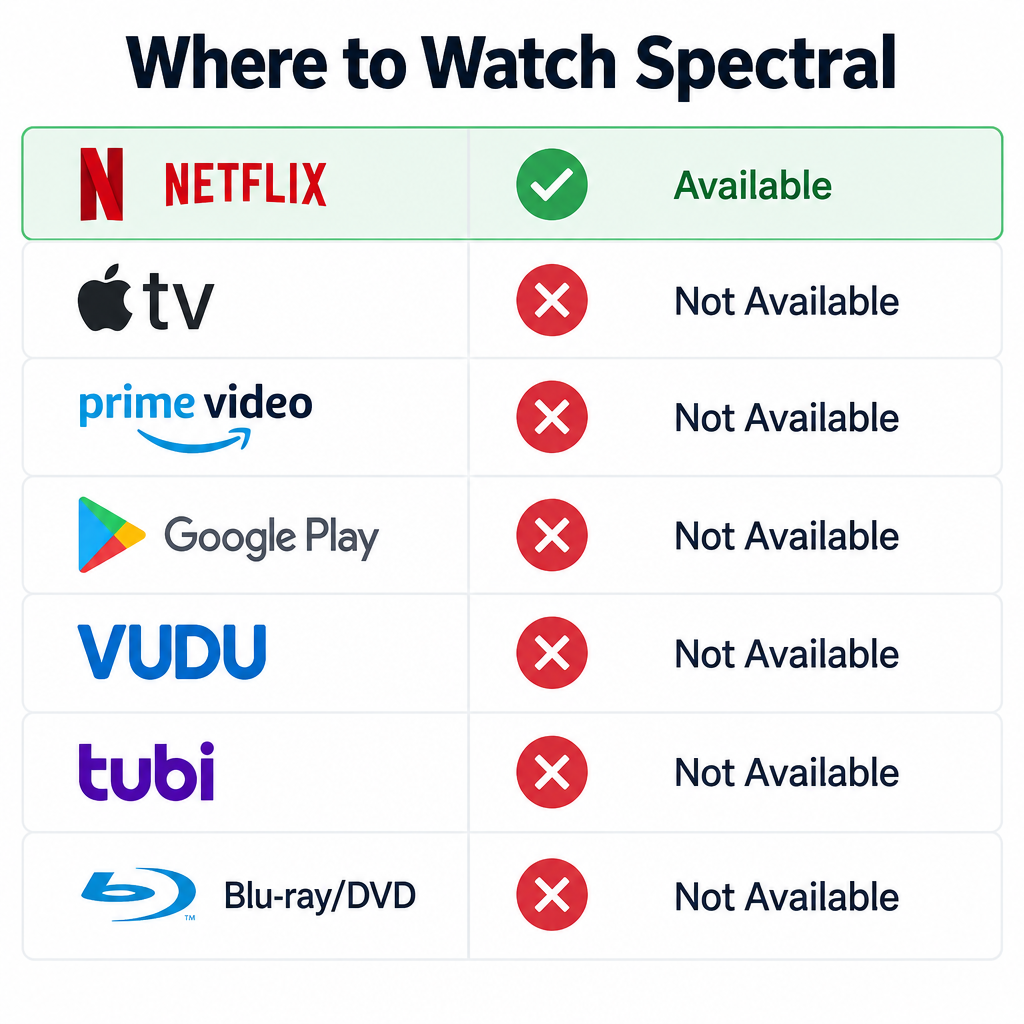
Spectral streams exclusively on Netflix, in every country where the service operates, and that is the only legal place to see it. You cannot rent or buy it from Apple TV, Amazon, Google Play or Vudu, and it has never had a proper disc release in the United States. If you have a Netflix login, you are 107 minutes away from one of the stranger stories in the streaming era: a $70 million Legendary Pictures war film that Universal pulled from theaters and sold to Netflix in 2016.
Key Takeaways
– Where to watch: Netflix only, worldwide, included with any subscription tier. No rental, purchase or free ad-supported option exists.
– What it is: A 2016 military sci-fi film directed by Nic Mathieu, starring James Badge Dale, Emily Mortimer and Bruce Greenwood.
– The pitch: Delta Force soldiers in Moldova are being killed by apparitions only visible through hyperspectral goggles, and a DARPA engineer is sent to figure out why.
– Verdict: Strong effects, a smart third-act reveal, flat characters. Worth a watch if you like Aliens, Edge of Tomorrow or the Call of Duty campaigns.
– Rating: 6.5/10.
Where to Watch Spectral Right Now
Netflix bought Spectral outright, so the film has lived on the platform since December 9, 2016 and has never left. Unlike licensed titles that rotate in and out, it carries the “Netflix Original” badge and should stay put indefinitely.
That exclusivity also explains why the usual fallbacks do not work. Searching the digital storefronts turns up nothing, and the occasional DVD you see on resale sites is typically an import pressed for a market outside the US.
| Platform | Availability | Cost | Notes |
|---|---|---|---|
| Netflix (all regions) | Streaming, included | Netflix subscription (ad-supported tier qualifies) | 4K and Dolby Vision on supported devices and plans |
| Apple TV / iTunes | Not available | n/a | Never released for purchase |
| Amazon Prime Video | Not available | n/a | Not for rent, purchase or Prime streaming |
| Google Play / YouTube Movies | Not available | n/a | No listing |
| Vudu / Fandango at Home | Not available | n/a | No listing |
| Tubi, Pluto TV, Freevee (free) | Not available | n/a | Netflix retains all rights |
| Blu-ray / DVD (US) | No official release | n/a | Some overseas imports circulate on eBay |
Netflix’s cheapest plan with ads includes the film, so a single month’s subscription remains the lowest-cost route. The movie is also downloadable through the Netflix app for offline viewing, which is useful since the darker night-vision sequences look noticeably worse over a poor connection.
What Spectral Is About
Moldova is in the middle of a civil war, and American special forces operating in the ruins of Chișinău keep turning up dead with no bullet wounds. Their bodies are flash-frozen from the inside. Helmet-mounted hyperspectral cameras, an experimental DARPA system, have captured ghostly human-shaped figures at the moment of each death.
Enter Dr. Mark Clyne, played by James Badge Dale, the engineer who designed those cameras. The Pentagon flies him to the forward base to confirm the footage is a glitch. General Orland, played by Bruce Greenwood, wants a quick answer so he can send more soldiers into the city. CIA officer Fran Madison, played by Emily Mortimer, suspects the insurgents have a new weapon.
Clyne quickly realizes the figures are not a sensor error. They are real, they are fast, they pass through walls, and anything they touch dies. Because they only register in the hyperspectral range, nobody can see them coming without his goggles.
A rescue mission to retrieve a trapped Delta team, led by Sergeant Major Sessions (Max Martini) and Captain Cabrera (Clayne Crawford), turns into a running retreat through apartment blocks and an abandoned factory. The soldiers learn two things the hard way: bullets do nothing, and iron filings and ceramic do something. Clyne spends the second half of the film reverse-engineering why.
I will keep the big reveal in its own section further down, with a spoiler warning. If you just want the headline, the “ghosts” are not supernatural at all.
How Spectral Ended Up on Netflix Instead of Theaters
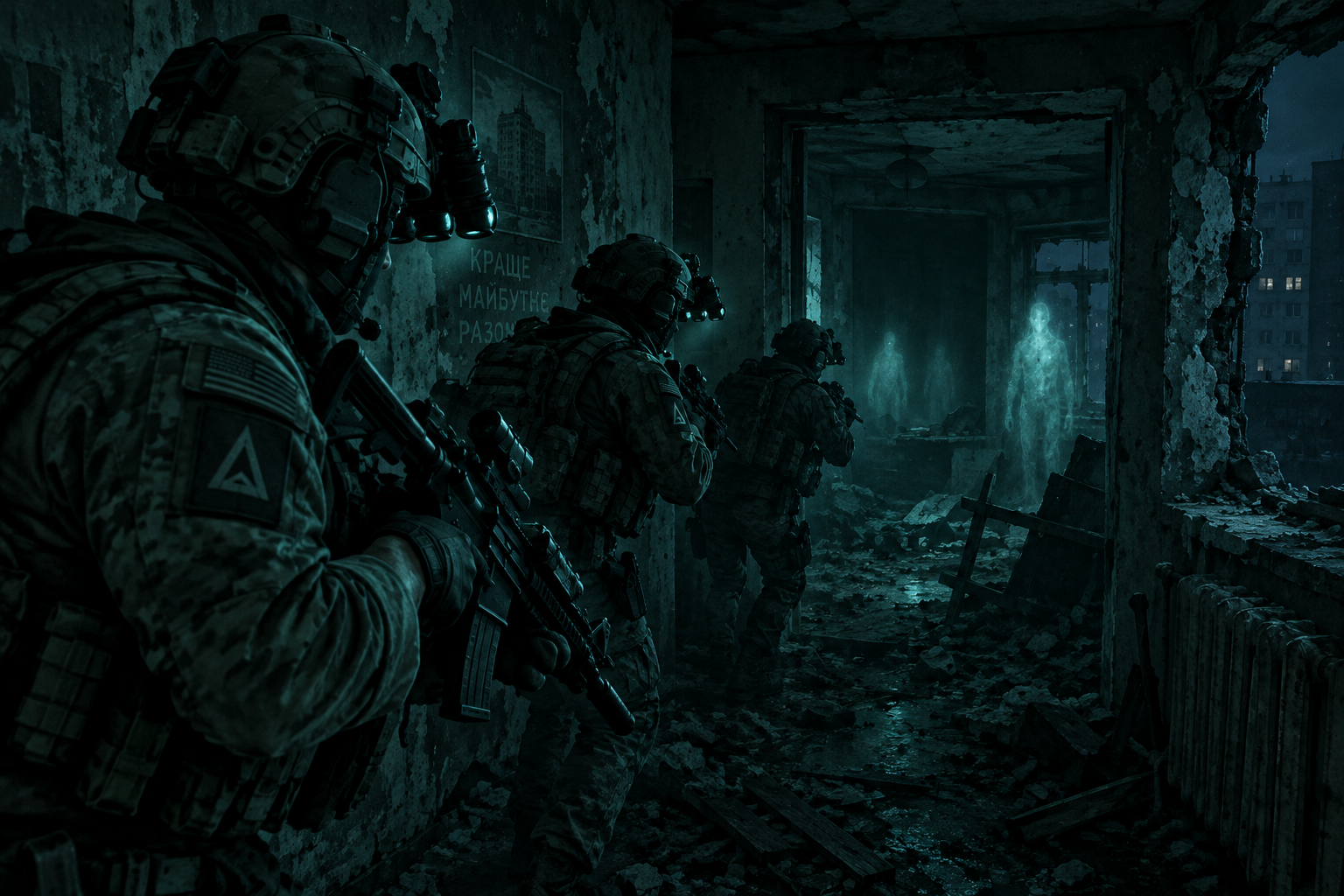
Spectral was not built to be a streaming movie. Legendary developed the project from an Ian Fried spec script, with George Nolfi (who directed The Adjustment Bureau) producing and sharing screenplay credit. Nic Mathieu, a commercials director making his feature debut, got the job. The budget landed around $70 million, which bought a shoot at Origo Studios in Budapest, creature and environment work from Weta Digital, and a score by Junkie XL, fresh off Mad Max: Fury Road.
Universal, Legendary’s distribution partner at the time, originally slotted the film for an August 2016 theatrical release. Trailers were cut, a poster went out, and then the date quietly disappeared. Legendary, now owned by the Chinese conglomerate Dalian Wanda, sold the finished film to Netflix instead. The streamer released it with minimal marketing on a Friday in early December, two weeks before Christmas.
That timing is why Spectral developed a word-of-mouth reputation rather than a box office record. Reddit threads with titles like “Spectral is a hidden gem” started appearing within days. For a lot of viewers it was the first time a movie that looked and sounded like a summer studio release had simply appeared in their Netflix queue.
Review: What Spectral Does Well
The apparitions are the best thing in the movie, and they are worth the price of admission on their own. Weta rendered them as pale, smeared human silhouettes that flicker in and out of the visible spectrum, and the first clear look at one, sprinting down a corridor toward a soldier’s camera, is a genuine jolt. Mathieu holds the shot a beat longer than you expect. The sound design helps, with a crackling static tone that cuts through the gunfire.
Mathieu also understands geography. The apartment-block ambush and the extended factory sequence are shot so you always know where the squad is, where the exits are, and where the things in the walls were last seen. Plenty of bigger-name action directors never manage that. For a first feature, the staging is confident.
The weapons are another highlight, and they come from an unusual place: the film actually thinks about its own rules. Once Clyne figures out that iron and ceramic interfere with the apparitions, the soldiers build improvised countermeasures. Iron-filing shotgun shells, ceramic plating on a Humvee, and eventually a set of pulse rifles assembled from base equipment. There is a twenty-minute stretch where the movie becomes a montage of engineers and grunts jury-rigging gear, and it is the most fun stretch of the film.
James Badge Dale carries the material. He plays Clyne as a tired technician rather than an action hero, and he sells the scientific exposition because he delivers it like someone annoyed at how obvious it should be. Bruce Greenwood brings his usual gravel, and Max Martini is convincing as a career NCO who stops arguing with the scientist the moment the scientist proves useful.
Finally, the third-act reveal is better than the genre average. Most “invisible killer” films either refuse to explain the threat or explain it with a shrug. Spectral commits to a specific, physical explanation, and the final set piece grows directly out of that explanation rather than ignoring it.
Review: Where It Falls Apart
Characters. The script gives almost no one a trait beyond their job title. Clyne is the engineer, Madison is the CIA officer, Orland is the general, and the soldiers are distinguished mostly by who dies when. Emily Mortimer, a terrific actress, is stuck delivering plot updates and gets one short scene that hints at an actual person. A Moldovan child the squad protects exists to be carried.
The dialogue does not help. Lines like “We’re going in blind, people” and “You don’t get to make that call” pile up, and the soldiers’ banter sounds like a video game lobby. When the movie does try for a thematic moment, usually about the ethics of weapons research, it lands on the nose and then moves on.
There is also a pacing lull around the midpoint. After the first big ambush, the film retreats to the base for a long stretch of briefings, and the energy drops. Mathieu seems more interested in the problem than the people, which works during the engineering scenes and hurts everywhere else.
The ending resolves too cleanly for a story this grim. Without spoiling it, the final two minutes trade an unsettling implication for a reassuring one, and the film is weaker for it.
The Science Behind the Apparitions (Spoilers)
Skip this section if you have not watched the film yet.
Clyne’s investigation leads to a research facility inside a disused power plant. The Moldovan government’s scientists, before the war, had been experimenting with Bose-Einstein condensates, a state of matter that occurs near absolute zero where atoms begin to behave as a single quantum entity. They had found a way to 3D-print a human nervous system in condensate form, using scans of living subjects.
The apparitions are those prints: copies of real people, held in a state so cold that contact instantly freezes living tissue. They pass through most matter because the condensate barely interacts with it, but iron disrupts the magnetic containment and ceramic insulates against the thermal effect. The original subjects are still alive, wired into the facility and kept in a coma to sustain the copies. Cutting the connection shuts the whole thing down.
Whether any of that survives contact with a physicist is beside the point. The film uses the science the way Aliens uses its xenomorph biology: as a consistent rule set that lets the characters make plans. Several Reddit threads have gone deep on whether the iron and ceramic logic holds up, and the fact that fans argue about it at all is a compliment. Most Netflix action films give you nothing to argue about.
Critics Reviews and Audience Reviews
Spectral did not get a wide critical rollout because Netflix did not screen it in advance. Reviews trickled in over the following weeks, and the pool stayed small. The consensus was mild approval: a well-made B-movie with A-movie effects and C-movie writing. Comparisons to Aliens, Black Hawk Down and Ghostbusters appeared in nearly every write-up, sometimes all three in one paragraph.
Audience reaction split along a predictable line. Viewers who came for the concept and the action mostly liked it. Viewers who wanted a thriller with people they cared about mostly did not.
| Source | Score (approximate, at time of writing) | Sample |
|---|---|---|
| IMDb user rating | 6.3 / 10 | Roughly 80,000+ votes |
| Rotten Tomatoes (critics) | Low 70s % | Fewer than 20 reviews |
| Rotten Tomatoes (audience) | Mid 50s % | Several thousand ratings |
| Letterboxd average | Around 3.0 / 5 | Tens of thousands of logs |
Those numbers shift over time, so treat them as a snapshot rather than a verdict. The spread is what matters. A 70-ish critics’ score against a mid-50s audience score is the opposite of the usual pattern for a genre film, and it reflects how the movie plays: professionals admire the craft, general audiences wanted more plot.
Letterboxd’s most-liked reviews are telling. Several are one-liners along the lines of “Call of Duty: Ghosts, but good,” which is both a joke and a fair summary.
Cast & Crew
| Name | Role |
|---|---|
| James Badge Dale | Dr. Mark Clyne, DARPA engineer |
| Emily Mortimer | Fran Madison, CIA officer |
| Bruce Greenwood | General Orland |
| Max Martini | Sergeant Major Sessions |
| Clayne Crawford | Captain Cabrera |
| Cory Hardrict | Delta Force operator |
| Gonzalo Menendez | Delta Force operator |
| Ursula Parker | Moldovan child survivor |
| Nic Mathieu | Director, co-writer |
| Ian Fried | Story, co-writer |
| George Nolfi | Co-writer, producer |
| Thomas Tull | Producer (Legendary) |
| Bojan Bazelli | Cinematographer |
| Junkie XL (Tom Holkenborg) | Composer |
| Weta Digital | Visual effects |
Dale is the name most viewers recognize from The Pacific, 13 Hours and Hightown. Greenwood had just played Captain Pike in the Star Trek reboots. Martini was coming off The Unit and Pacific Rim, which explains why he looks so at home shouting over gunfire. Mathieu has not directed another feature since, which is a shame given how well he handles action.
Movie Info
| Detail | Information |
|---|---|
| Title | Spectral |
| Release date | December 9, 2016 (Netflix) |
| Original plan | Universal theatrical release, August 2016 (cancelled) |
| Director | Nic Mathieu |
| Runtime | 107 minutes |
| Rating | TV-14 (Netflix); no MPAA rating |
| Genre | Science fiction, action, military thriller |
| Studio | Legendary Pictures |
| Distributor | Netflix |
| Budget | Approximately $70 million |
| Filming location | Budapest, Hungary (Origo Studios) |
| Setting | Chișinău, Moldova |
| Language | English, with some Moldovan/Romanian |
Spectral is one of the earliest examples of Netflix acquiring a finished studio tentpole rather than financing from scratch. The strategy would be repeated with The Cloverfield Paradox (Paramount, 2018), Extinction (Universal, 2018) and later Army of the Dead’s distribution rights. If you track how streaming reshaped mid-budget sci-fi, this film is a useful marker.
Similar Films to Watch Next
If Spectral scratched an itch, these are the closest matches, with notes on where they currently sit.
- Aliens (1986). The template for soldiers-versus-unknown with a civilian expert who turns out to be right. Streams on Hulu and Disney+ in the US, rentable everywhere.
- Edge of Tomorrow (2014). Hard sci-fi military action with a strong gimmick and an engineer’s approach to problem-solving. Widely available for rent, often on Max.
- Outside the Wire (2021). Netflix’s own follow-up to the Spectral formula, with Anthony Mackie as an android officer. Weaker, but tonally adjacent.
- The Cloverfield Paradox (2018). Another Netflix acquisition of a studio sci-fi film. Messier than Spectral, but the same industry story.
- Predator (1987). Special forces in a hostile zone picked off by something that can only be seen under certain conditions. Streams on Hulu and Disney+, rentable everywhere.
- Kill Command (2016). Low-budget British film released the same year, soldiers against self-evolving machines. On Tubi free in the US at various points.
The soldiers-with-a-scientist structure is older than any of these, going back to Howard Hawks’ The Thing from Another World in 1951. Spectral belongs to that lineage, and it holds up better than most recent attempts.
My Rating
6.5 out of 10.
That number sounds like a shrug, so here is what it means in practice. Spectral is a genuinely well-crafted action film with an inventive premise, sold short by a script that never builds anyone worth worrying about. The effects, the staging and the final-act explanation are all above the line. The dialogue and characters are below it.
Watch it on a big screen with the sound up, and go in expecting an elevated Call of Duty campaign rather than a thriller. On those terms it delivers. If you want the Netflix original that people mean when they say “hidden gem,” this is one of the few that earns the label on craft alone, even if it never earns it on heart.
FAQ
Where can I watch Spectral?
Netflix, and only Netflix. The film is a Netflix original available in every region where the service operates, including on the ad-supported plan. It is not available to rent or buy from Apple, Amazon, Google or Vudu, and there is no free ad-supported streaming option.
Is Spectral on Amazon Prime Video or Hulu?
No. Netflix owns the worldwide rights outright, so Spectral has never appeared on Prime Video, Hulu, Max, Paramount+ or any other streaming service. Listings you may see on third-party aggregator sites for other platforms are errors.
Is Spectral based on a book or video game?
No. Ian Fried wrote the original story, and the screenplay was developed by Fried, George Nolfi and director Nic Mathieu. The Call of Duty comparisons come from the look and structure, not from any licensing connection.
Will there be a Spectral 2?
Nothing has ever been announced. Netflix has not publicly reported viewing figures for the film, Mathieu has not directed a feature since, and Legendary’s deal gave Netflix the rights to a finished movie rather than a franchise. The ending leaves room for a sequel, but after nearly a decade with no news, treat it as a standalone.
Is Spectral scary or more of an action movie?
Mostly action. The first apparition attack and a couple of corridor sequences are tense, and the frozen-body imagery is grim, but the film quickly shifts into soldiers-versus-monsters mode with heavy weapons fire. The TV-14 rating is accurate: violent but not gory, with mild language.
What are the ghosts in Spectral?
Without spoiling the specifics, they are not supernatural. The film gives a scientific explanation involving Bose-Einstein condensates and human test subjects, which is why iron and ceramic affect them when bullets do not. The spoiler section above lays out the full reveal.
