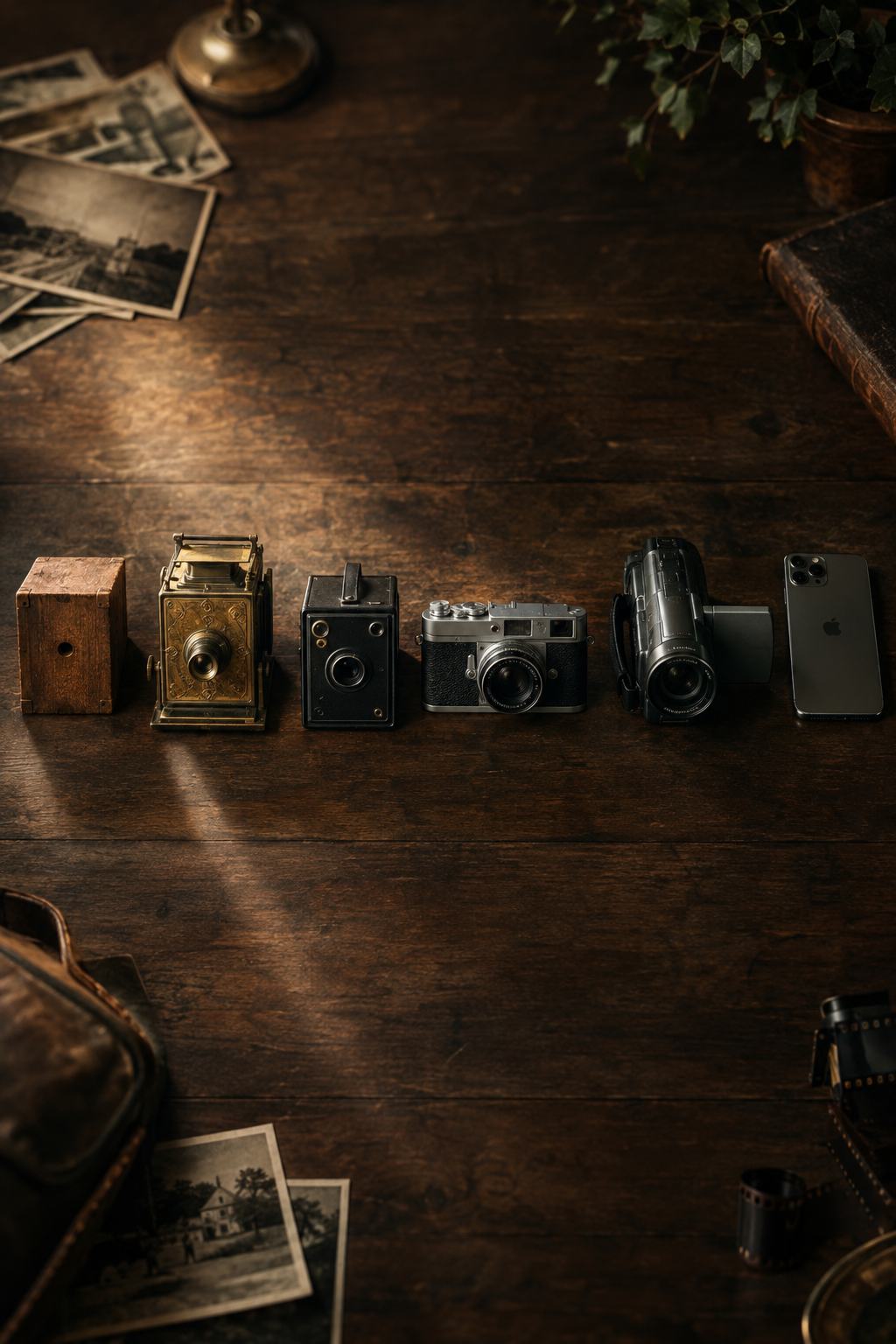
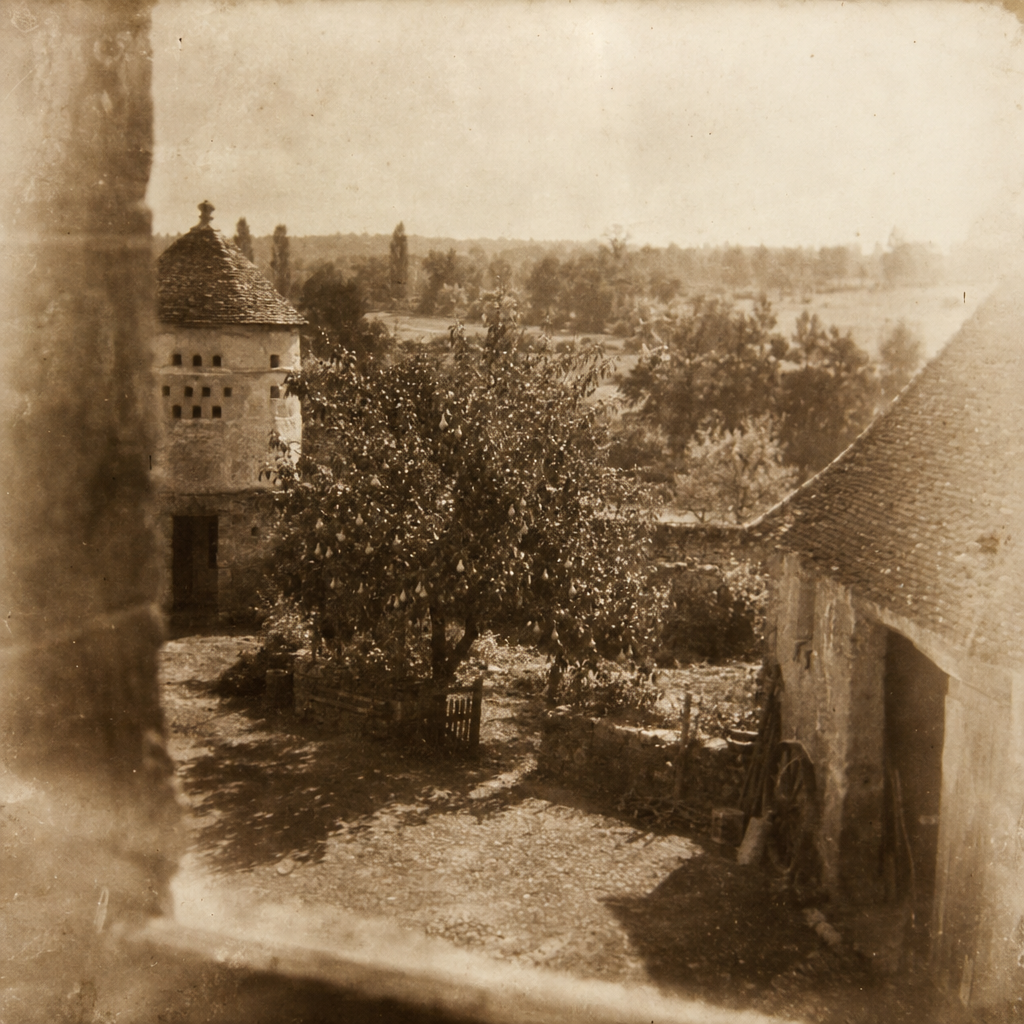
The oldest surviving photograph shows a pigeon house, a sloping barn roof and a pear tree outside an upstairs window in rural Burgundy, and it took at least eight hours to expose. Nicéphore Niépce made it around 1826, which is the short answer to when the camera was invented, if by camera we mean a box that captures a permanent image. The longer answer stretches back a thousand years to a darkened room with a pinhole, and forward to the phone in your pocket, and it runs straight through the history of movies.
The Short Answer
Three dates matter, depending on what you mean by “camera.”
The camera obscura, a dark chamber that projects an upside-down image of the world through a small hole, was described by Ibn al-Haytham in Cairo around 1021, and Chinese philosopher Mozi noted the effect roughly 1,500 years before that. The first camera to fix a permanent photograph was Niépce’s, around 1826, in France. The first commercially manufactured camera, the Giroux daguerreotype outfit, went on sale in Paris in 1839, the year photography was announced to the public.
Motion picture cameras arrived in 1888 with Louis Le Prince, electronic video cameras in the late 1920s, and the first digital still camera in a Kodak lab in December 1975.
Key Takeaways
– The camera obscura is ancient; the camera that records images dates to Niépce around 1826.
– 1839 is photography’s public birth year: Daguerre in France, Talbot in England, the first camera for sale.
– Glass negatives (1851) and dry plates (1871) made photography practical; Kodak roll film (1888) made it popular.
– The first film camera shot moving pictures in Leeds in October 1888.
– Color stills went mainstream with Autochrome (1907); color movies with Technicolor’s three-strip process (1932 onward).
– Electronic video cameras date to 1927, the first digital camera to 1975, and the first camera phone to 1999.
Camera History Timeline
| Year | Milestone | Who |
|---|---|---|
| c. 400 BCE | Pinhole image described | Mozi, China |
| c. 1021 | Camera obscura explained in the Book of Optics | Ibn al-Haytham |
| 1604 | The term “camera obscura” coined | Johannes Kepler |
| 1685 | Portable reflex camera obscura designed | Johann Zahn |
| c. 1826 | First surviving photograph, “View from the Window at Le Gras” | Nicéphore Niépce |
| 1835 | Oldest surviving paper negative, Lacock Abbey | William Henry Fox Talbot |
| 1839 | Daguerreotype announced; first camera sold | Louis Daguerre, Alphonse Giroux |
| 1841 | Calotype negative-positive process patented | Talbot |
| 1851 | Wet collodion glass negative | Frederick Scott Archer |
| 1861 | First color photograph demonstrated | James Clerk Maxwell |
| 1871 | Gelatin dry plate | Richard Leach Maddox |
| 1878 | Galloping horse captured by 12 cameras | Eadweard Muybridge |
| 1888 | Kodak box camera; first motion picture film | George Eastman; Louis Le Prince |
| 1895 | Cinématographe public screening in Paris | Auguste and Louis Lumière |
| 1900 | Kodak Brownie, $1 | Eastman Kodak |
| 1907 | Autochrome color plates on sale | Lumière brothers |
| 1925 | Leica I, the 35mm camera | Oskar Barnack, Leitz |
| 1927 | Electronic image transmitted | Philo Farnsworth |
| 1935 | Kodachrome; first three-strip Technicolor feature | Kodak; “Becky Sharp” |
| 1948 | Polaroid Model 95 instant camera | Edwin Land |
| 1956 | Videotape recording | Ampex |
| 1975 | First digital camera prototype | Steven Sasson, Kodak |
| 1983 | First camcorder, Sony Betamovie | Sony |
| 1999 | First camera phone, Kyocera VP-210 | Kyocera |
| 2007 | iPhone; RED One digital cinema camera | Apple; RED |
Before Photography: The Camera Obscura
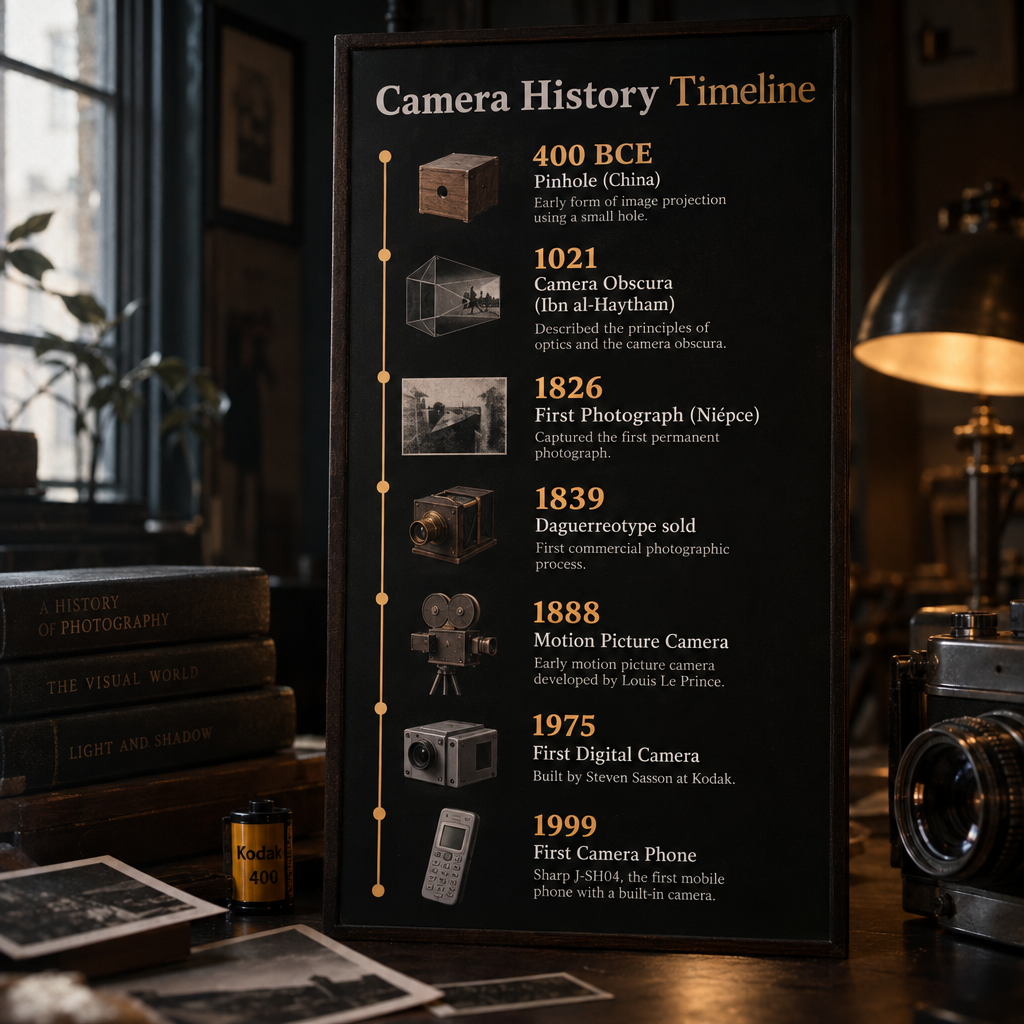
Every camera starts with the same trick. Light passes through a small opening into a dark space and paints an inverted image on the far wall. Mozi wrote about it in China in the 5th century BCE, Aristotle noticed it during a solar eclipse, and Ibn al-Haytham (Alhazen) worked out the optics in his Book of Optics, written in Cairo between roughly 1011 and 1021. He used the device to prove that light travels in straight lines and that vision works by light entering the eye, not leaving it.
For centuries the camera obscura was a room, literally. Johannes Kepler gave it the Latin name in 1604, and by 1685 the German monk Johann Zahn had sketched a portable box with a lens, a mirror and a ground-glass screen. Flip the mirror, and you have the basic design of a reflex camera, two centuries before anyone could record what it showed.
Painters leaned on it heavily. Canaletto almost certainly used one for his Venetian views, and the argument over whether Vermeer did too has fueled an entire subgenre of art-history fights. If you want the most entertaining version of that debate, “Tim’s Vermeer” (2013), directed by Teller of Penn & Teller, follows a Texas inventor as he rebuilds a 17th-century optical rig and paints “The Music Lesson” from scratch. It rents on Apple TV and Amazon and is a good primer on why optics came long before chemistry.
That was the sticking point. By 1800 the camera existed; the photograph did not. Thomas Wedgwood, son of the pottery family, laid objects on leather soaked in silver nitrate and got silhouettes, but had no way to stop the image from darkening. Humphry Davy published their results in 1802 and admitted defeat on fixing.
The First Photo Ever Taken
Niépce solved it with tar. A gentleman inventor from Chalon-sur-Saône, he had already co-invented an internal combustion engine with his brother Claude when he turned to what he called heliography, “sun writing,” around 1816. His early experiments produced faint paper negatives that faded within hours.
The breakthrough material was bitumen of Judea, an asphalt that hardens where light strikes it. Niépce coated a pewter plate with the stuff, loaded it into a camera obscura bought from the Paris optician Charles Chevalier, and pointed it out the window of his estate at Le Gras. Exposure took the rest of the day, probably longer. Historian Helmut Gernsheim, who rediscovered the plate in 1952, estimated eight hours; later researchers argue for several days, which explains why sunlight appears on both sides of the courtyard. Washing the plate with lavender oil dissolved the unhardened bitumen and left a ghostly positive of rooftops.
“View from the Window at Le Gras” now sits in a climate-controlled case at the Harry Ransom Center at the University of Texas at Austin, which is about as far from a Burgundy farmhouse as you can get. We can argue about whether 1826 or 1827 is the right year, since Niépce’s own notes are vague, but the photograph itself is the one thing nobody disputes.
He died in 1833, broke and obscure, four years into a partnership with a Parisian theater painter named Louis Daguerre. Daguerre took the research somewhere Niépce never could.
1839: The Year the Camera Went Public
Daguerre swapped bitumen for silver-plated copper sensitized with iodine vapor and discovered, apparently by accident, that mercury fumes would bring out a latent image after an exposure of minutes rather than hours. His 1838 shot of the Boulevard du Temple, taken from his studio window, is the first photograph with people in it: a man getting his boots shined stood still long enough to register while the traffic vanished.
On January 7, 1839, physicist François Arago announced the daguerreotype to the French Academy of Sciences without revealing how it worked. The French government then bought the process outright, paying Daguerre a pension of 6,000 francs a year and Niépce’s son Isidore 4,000, and published the working details on August 19, 1839 as a gift “free to the world.” Within weeks, Paris opticians were selling out of lenses and silver plates.
The first camera you could walk into a shop and buy appeared that same month. Alphonse Giroux, a relative of Daguerre’s wife, manufactured a wooden sliding-box camera with a Chevalier lens, stamped with Daguerre’s signature as proof of authenticity. It cost 400 francs, the price of a decent Paris apartment for a year, and the complete outfit weighed more than 100 pounds. We would call it a kit camera today. Daguerre made a cut on every one.
Across the Channel, William Henry Fox Talbot read the January announcement with horror, because he had been doing the same thing in secret since 1834. His tiny 1835 negative of a lattice window at Lacock Abbey, made in a wooden “mousetrap” camera his wife named, is the oldest surviving camera negative. By 1841 he had patented the calotype, which used paper negatives to make unlimited positive prints. That negative-positive logic, not Daguerre’s one-off mirror images, became the template for the next 150 years of photography and for every roll of movie film ever printed.
Two more 1839 names deserve a mention. Hippolyte Bayard invented a direct-positive paper process and, after Arago sidelined him in favor of Daguerre, staged “Self Portrait as a Drowned Man” (1840), the first photographic protest and arguably the first fake news image. And in Philadelphia, chemist Robert Cornelius set up a camera outside his family’s lamp store that October, ran into frame, and held still for about a minute. The result is the first photographic portrait made in America and, yes, the first selfie.
Early Photography and the Origin of Copyright
The camera created a legal problem on day one: who owns a picture of the world?
Daguerre’s answer was patents. Five days before France released his process free to the world, he quietly patented it in England, so British photographers had to pay. Richard Beard bought the English rights and opened the country’s first portrait studio at London’s Royal Polytechnic in March 1841, then spent a fortune suing infringers. Talbot did the same with his calotype, licensing it so tightly that English paper photography lagged behind France and Scotland, where the patent did not apply. He only relaxed the terms in 1852 under pressure from the Royal Society.
Copyright as we understand it came later, and it came through portraits. Britain’s Fine Arts Copyright Act of 1862 was the first law anywhere to give photographs the same protection as paintings. In the United States, the question reached the Supreme Court in 1884 in Burrow-Giles Lithographic Co. v. Sarony, over a lithograph copied from Napoleon Sarony’s 1882 studio portrait of Oscar Wilde, the one with the fur-trimmed coat. Burrow-Giles argued a photograph was mere mechanical reproduction with no author. The court disagreed, ruling that Sarony’s choices of pose, costume, lighting and arrangement made the image an original work. Every photo credit, every image license and every argument about who owns a film still traces back to that case.
That ruling is also why the question of authorship keeps resurfacing with each new camera. Sarony’s “author” was the person who arranged the scene, which maps neatly onto a film director. It maps less neatly onto a monkey who grabbed a wildlife photographer’s camera in 2011, which is a story for another day.
When Was the First Glass Negative Invented?
Daguerreotypes were sharp but unique. Calotypes were reproducible but soft, because the paper fibers blurred the image. The obvious fix was glass, and the problem was getting silver chemistry to stick to it.
Niépce’s cousin Abel Niépce de Saint-Victor managed it first in 1847 using egg white, the albumen-on-glass process, which was sharp but slow. The real answer came in 1851 from Frederick Scott Archer, a London sculptor who dissolved guncotton in ether to make collodion, a syrupy varnish that held silver salts on glass. His wet collodion process cut exposures to a few seconds and produced negatives sharp enough to print at any size. Archer published it freely in The Chemist, never patented it, and died penniless in 1857 while others got rich.
The catch was the word “wet.” A plate had to be coated, exposed and developed within about ten minutes, before the collodion dried. So photographers hauled darkrooms with them. Roger Fenton brought a converted wine merchant’s wagon to the Crimean War in 1855. Mathew Brady’s teams did the same across Civil War battlefields, which is why Brady’s studio at Broadway and Tenth Street in Manhattan became the first place Americans saw dead soldiers on a wall.
Wet collodion also gave us cheap portraits. The ambrotype (a collodion negative backed with black to read as a positive) and the tintype (the same idea on lacquered iron, patented in 1856) put a likeness within reach of anyone with a quarter. Tintypes are the reason so many Civil War soldiers have faces.
The dry plate ended the darkroom wagon. Richard Leach Maddox, an English doctor sick of ether fumes, proposed a gelatin emulsion in 1871, and by 1878 Charles Bennett had made it fast enough for exposures of a fraction of a second. Plates could now be manufactured in factories, stored for months and developed at leisure. Hand-held cameras became possible. So did the shutter, since for the first time human hands were too slow to time the exposure.
Muybridge and the Camera That Learned to Move
A fraction of a second changes what photography is for. On June 15, 1878, at Leland Stanford’s farm in Palo Alto, Eadweard Muybridge set a dozen cameras along a track, rigged their shutters to trip wires, and photographed a mare named Sallie Gardner at a gallop. The plates settled a bet (all four hooves do leave the ground, though not in the rocking-horse pose painters imagined) and did something bigger. Laid side by side, they were a film strip without the film.
Muybridge built the zoopraxiscope in 1879 to project his sequences as moving images, which makes him a plausible candidate for the first motion picture. Film historians usually stop short of that, since the device used painted copies rather than photographs. But he toured Europe with it, and among the people who saw his work was the French physiologist Étienne-Jules Marey, who in 1882 built a “chronophotographic gun” that shot twelve frames a second on a single rotating plate. The single-camera moving image was now one step away, and that step was flexible film.
Kodak and the 1890s: Photography for Everyone
George Eastman, a Rochester bank clerk, hated lugging wet plates on vacation. By 1880 he was manufacturing dry plates, and in 1888 he launched a camera that removed every remaining obstacle. The original Kodak was a leatherette box with a fixed-focus lens, one shutter speed and a roll of paper film loaded for 100 round exposures. It cost $25. When the roll ran out, the owner mailed the whole camera to Rochester, paid $10, and got it back reloaded with the prints. The slogan was “You press the button, we do the rest,” and it may be the most consequential sentence in the history of the camera.
Transparent celluloid roll film followed in 1889, replacing paper. Eastman’s chemist Henry Reichenbach developed it, though an Episcopal minister from Newark named Hannibal Goodwin had filed for a patent on the same idea in 1887. Goodwin’s patent took eleven years to be granted, his heirs sold it to Anthony & Scovill, the Manhattan supply house that became Ansco, and in 1914 Kodak paid $5 million to settle the infringement suit. The same strip of flexible film, perforated and run through a different mechanism, was about to become the movies.
Through the 1890s, cameras got smaller and cheaper every year. The 1895 Pocket Kodak fit in a coat; the 1898 Folding Pocket Kodak set the 2¼ by 3¼ inch negative format that lasted decades. Newspapers complained about “Kodak fiends” photographing people without permission on beaches and at train stations, the first moral panic about cameras in public. Hand-held snapshooting also produced a new kind of picture: candid, off-kilter, unposed. Jacob Riis was photographing Lower East Side tenements with magnesium flash powder for “How the Other Half Lives” (1890), and Alfred Stieglitz was shooting Fifth Avenue in a snowstorm with a hand camera, which the art photographers of the day considered beneath them.
The Most Popular Camera of the 1900s
That would be the Kodak Brownie, launched in February 1900 at a price of $1, with film at 15 cents a roll. Frank Brownell designed it as a cardboard box with a meniscus lens, named after Palmer Cox’s cartoon elves, and aimed it at children. Kodak sold around 150,000 in the first year, and the No. 2 Brownie of 1901 introduced the 120 film size that medium-format photographers still use today. For most of the 20th century, the first camera a person ever held was a Brownie.
The First Film Camera: Moving Pictures, 1888 to 1896
The first camera built to shoot a motion picture was not Edison’s. Louis Le Prince, a French inventor working in Leeds, England, built a single-lens camera that pulled paper-backed film past the gate and exposed it at around twelve frames per second. On October 14, 1888, he filmed his in-laws walking in a garden at Roundhay. The surviving two seconds, “Roundhay Garden Scene,” are the oldest motion picture footage in existence. He shot traffic on Leeds Bridge the same month.
Then he vanished. In September 1890, weeks before a planned public demonstration in New York, Le Prince boarded a train from Dijon to Paris and was never seen again. His widow spent years convinced Edison was behind it. The 2015 documentary “The First Film,” by David Nicholas Wilkinson, makes the case for Le Prince as the father of cinema, and it rents on Amazon and Apple TV.
Thomas Edison’s contribution was organizational. He assigned W.K.L. Dickson to the problem in 1888, and by 1891 Dickson had the Kinetograph, a camera that used Eastman’s 35mm celluloid, perforated with four holes per frame, and a stop-motion mechanism that held each frame still during exposure. That film gauge and perforation pattern are still the industry standard. Edison’s playback device, the Kinetoscope, was a peep-show cabinet, and the first parlor opened at 1155 Broadway in Manhattan on April 14, 1894, with ten machines at 25 cents a look.
The Lumière brothers of Lyon, who already ran Europe’s largest photographic plate factory, saw a Kinetoscope and decided projection was the better business. Their Cinématographe, patented February 13, 1895, was a camera, printer and projector in one wooden box, light enough to carry and hand-cranked at 16 frames per second. On December 28, 1895, they charged admission at the Salon Indien of the Grand Café in Paris for ten short films, including “Workers Leaving the Lumière Factory.” That night is the conventional birthday of cinema as a public event.
New York got its first projected movies four months later. Edison’s Vitascope, actually designed by Thomas Armat and C. Francis Jenkins, premiered on April 23, 1896 at Koster & Bial’s Music Hall on 34th Street, where Macy’s stands now. A year later, J. Stuart Blackton and Albert E. Smith founded Vitagraph, and by 1906 they had built a glass-roofed studio in Midwood, Brooklyn, at East 14th Street and Locust Avenue. The smokestack with VITAGRAPH in white brick is still there, which makes it the oldest surviving piece of movie infrastructure in the city.
Studio cameras standardized fast. The Bell & Howell 2709 of 1912, the first all-metal production camera, became the Hollywood workhorse and shot most of Chaplin’s films; a Mitchell replaced it as the sound-era standard from 1934. If you want to see the hardware, the Museum of the Moving Image in Astoria has a Mutoscope you can crank and a floor of early cameras.
The Most Popular Camera of the 1920s
For still photographers, the 1920s belong to two machines at opposite ends of the market. The Vest Pocket Kodak, introduced in 1912 and sold in Autographic form from 1915, went to war in millions of soldiers’ pockets and was still the best-selling folding camera a decade later. At the other end sat the Leica I, which Leitz unveiled at the Leipzig Spring Fair in 1925.
Oskar Barnack, a Leitz engineer with asthma who could not carry a plate camera, had built his prototype in 1913 by turning Edison’s 35mm movie film sideways and doubling the frame to 24 by 36mm. The Leica was small enough to hide, fast enough to shoot in available light and sharp enough to enlarge. Henri Cartier-Bresson bought one in 1932 and spent the next 70 years proving the point. Add the twin-lens Rolleiflex of 1929, and the whole visual language of 20th-century photojournalism was in place before the Depression.
When Did Color Photography Start?
Earlier than most people assume. On May 17, 1861, James Clerk Maxwell stood up at the Royal Institution in London and projected three black-and-white lantern slides of a tartan ribbon, shot by Thomas Sutton through red, green and blue filters, through matching filters onto a screen. The overlapping images produced a recognizable color photograph. The physics of every color sensor since, including the one in your phone, is Maxwell’s three-color principle.
Turning the principle into a product took 46 years. Gabriel Lippmann produced true-color plates by interference in 1891 and won a Nobel Prize for it in 1908, but the process was impractical. The first commercial color photography was Autochrome, patented by the Lumière brothers in 1903 and sold from 1907: a glass plate coated with microscopic grains of potato starch dyed red, green and blue, acting as a mosaic filter over a panchromatic emulsion. Autochromes are soft, grainy and gorgeous, like pointillist paintings, and they dominated color stills for nearly three decades.
Kodachrome replaced them. Developed by Leopold Godowsky Jr. and Leopold Mannes, two professional musicians who did chemistry in their spare time, it launched in 1935 as 16mm movie film and came to 35mm stills in 1936. It was the first subtractive color film that amateurs could load into a regular camera, and its reds and Kodachrome blues defined the look of mid-century America until Kodak discontinued it in 2009. Mark Raso’s “Kodachrome” (2017), with Ed Harris as a dying photographer racing to the last lab in Kansas that still processes it, is a Netflix original and streams there.
The First Color Film
Audiences saw color movies before there was color film stock. Georges Méliès had his prints hand-painted frame by frame in Elisabeth Thuillier’s Paris workshop, and a hand-colored print of “A Trip to the Moon” (1902) survived and was restored in 2011. Tinting whole scenes blue for night or amber for interiors was standard practice through the silent era.
The first commercially successful natural-color motion picture process was Kinemacolor, patented by George Albert Smith in Brighton in 1906 and shown publicly from 1908. It shot alternating frames through red and green filters on a rotating wheel and projected them back the same way, at double speed. The flicker and fringing on fast movement limited it, but Kinemacolor ran in theaters for a decade.
Technicolor, founded in Boston in 1915 by MIT graduates Herbert Kalmus, Daniel Comstock and W. Burton Wescott, went through several generations. The two-color subtractive process produced “The Toll of the Sea” (1922), the first general-release color feature, with Anna May Wong. Then came the three-strip camera of 1932, a beam-splitting monster that exposed three separate negatives at once and required blazing light on set. Disney’s “Flowers and Trees” (1932) was the first film shot with it, “Becky Sharp” (1935) the first live-action feature, and 1939 delivered “The Wizard of Oz” and “Gone with the Wind.” Three-strip Technicolor cameras were rented, never sold, always came with a Technicolor consultant, and were retired in 1955 once Eastmancolor single-strip negative made them obsolete. Film Forum runs a Technicolor print of “Oz” or “Singin’ in the Rain” (1952) most years, and the difference from a digital projection is not subtle.
The First Video Camera
Here we need to separate film from video. A film camera records light chemically; a video camera converts it to an electrical signal. The second idea came out of television research in the 1920s.
Vladimir Zworykin, a Russian émigré at Westinghouse, filed a patent for an electronic camera tube in 1923, and his Iconoscope was working at RCA by 1933. But Philo Farnsworth, a 21-year-old Mormon farm kid working in a San Francisco loft, got there first in practice: on September 7, 1927, his image dissector tube transmitted a straight line to a receiver in the next room. The ensuing patent war between Farnsworth and RCA ran a decade, and Farnsworth mostly won. Every live TV broadcast from the 1939 World’s Fair in Queens onward used a descendant of those tubes.
For its first three decades, video could only be recorded by pointing a film camera at a monitor, the kinescope, until Ampex demonstrated the VRX-1000 videotape recorder at the National Association of Radio and Television Broadcasters convention on April 14, 1956, a machine that cost $50,000. The Sony DV-2400 Portapak of 1967 put a reel-to-reel recorder and a camera on a shoulder strap and launched video art; Nam June Paik bought one of the first in New York. Sony’s Betamovie BMC-100 of 1983 was the first camcorder, combining camera and recorder in one hand-held unit, and the 8mm Handycam of 1985 shrank it to palm size. That is the camera that recorded a generation of birthday parties, and the camera that let Richard Linklater and the early Sundance crowd shoot features for the cost of tape.
When Did Digital Photography Start?
The first digital camera was built at Kodak, by a 24-year-old engineer named Steven Sasson, in December 1975. It weighed eight pounds, used a Fairchild CCD sensor of 100 by 100 pixels (0.01 megapixels), took 23 seconds to record a black-and-white image onto a cassette tape, and needed a custom playback box to show it on a television. Sasson’s bosses asked why anyone would want to look at pictures on a TV. Kodak patented it and then, famously, sat on it.
Commercial digital cameras trickled out over the next twenty years. Fuji’s DS-1P of 1988 recorded to a memory card but barely shipped. The Dycam Model 1 of 1990, sold by Logitech as the Fotoman, was the first digital camera consumers could buy, at 376 by 240 pixels in grayscale. The Kodak DCS 100 of 1991 bolted a 1.3-megapixel sensor to a Nikon F3 body with a separate hard-drive pack and cost somewhere between $20,000 and $30,000 depending on configuration; newspaper photographers bought them anyway, because transmitting a file beat couriering film. Apple’s QuickTake 100 (1994, designed by Kodak and manufactured by Chinon) brought color digital down to $750, and the Casio QV-10 (1995) was the first with an LCD screen on the back, which turned out to be the feature that mattered.
The Nikon D1 of 1999 was the first professional digital SLR designed from scratch, at 2.7 megapixels and about $5,000, and it ended the film era in newsrooms within three years. The same year Kyocera released the VP-210 in Japan, the first phone with a built-in camera. Apple’s original iPhone in 2007 shipped with a 2-megapixel camera that could not shoot video; by 2010 the iPhone 4 could, and by the mid-2010s the phone had become the most-used camera on earth by a wide margin.
The crossover moment for filmmakers was Canon’s EOS 5D Mark II in September 2008, a $2,700 still camera that happened to shoot full-HD video on a full-frame sensor. Within two years the season six finale of “House” had been shot entirely on it. That camera is the reason a shallow-focus, cinematic look stopped being expensive.
Digital Cinema: From “Attack of the Clones” to the iPhone
Hollywood went digital in stages. George Lucas shot “Star Wars: Episode II – Attack of the Clones” (2002) entirely on Sony’s HDW-F900 CineAlta, a 24-frame HD video camera developed with Panavision, and most of the industry hated the result. The images were clean and flat, and the camera’s 2/3-inch sensors could not deliver the shallow depth of field audiences associated with film. For anyone studying sci fi cinematography, the “Clones” to “Revenge of the Sith” (2005) period is a useful case study in what early digital could and could not do, especially combined with the chroma key green screen work that Lucas pushed harder than anyone before him.
Two cameras changed the argument. The RED One, shipping in 2007 with a 4K sensor the size of a 35mm film frame, gave digital the look of film at a fraction of the rental cost; Steven Soderbergh’s “Che” (2008) and David Fincher’s “The Social Network” (2010) made the case. Then the ARRI Alexa arrived in 2010, and its handling of highlights and skin finally stopped the “but film looks better” conversation for most cinematographers. Since 2013 the majority of studio features have been shot on Alexa or its successors, and Kodak now makes motion picture film for a small, stubborn and well-funded minority that includes Christopher Nolan and Quentin Tarantino.
The other end of the market is more fun. Sean Baker shot “Tangerine” (2015) on three iPhone 5S handsets with $8 app software and a clip-on anamorphic adapter, and it played Sundance looking like a real movie. Danny Boyle and Anthony Dod Mantle went further with “28 Years Later” (2025), shooting most of it on iPhone 15 Pro Max bodies rigged into custom frames, with one sequence using a 20-phone array for bullet-time effects. We have arrived at the point where the camera Niépce would recognize, a lens and a box, has disappeared into a slab of glass that also makes phone calls.
The 10 Most Important Photography Innovations
Ranked by how much each one changed what people could actually do with a camera.
- Fixing the image (Niépce, 1826; Daguerre and Talbot, 1839). Without a permanent picture there is no photography, full stop.
- The negative-positive process (Talbot, 1841). One exposure, unlimited prints. It is the logic of every film print, every photo lab and every JPEG copy.
- Flexible roll film (Eastman, 1888–89). Made the hand camera possible and made movies possible, in that order.
- The gelatin dry plate (Maddox, 1871). Freed photographers from the darkroom wagon and introduced the fast shutter.
- Intermittent film movement (Le Prince, Dickson, Lumière, 1888–95). The claw-and-shutter mechanism that holds each frame still is the heart of every film camera.
- The 35mm still camera (Barnack, 1925). Small, fast, discreet. Photojournalism and street photography grew out of this one box.
- Three-color subtractive film (Kodachrome and Technicolor, 1932–35). Practical color for both stills and movies.
- The CCD image sensor (Boyle and Smith, Bell Labs, 1969; Sasson’s camera, 1975). Light to electrons; the end of chemistry.
- The through-the-lens reflex viewfinder (Kine Exakta, 1936; Nikon F, 1959). What you see is what you get, which is why SLRs ran professional photography for 60 years.
- The camera phone (Kyocera, 1999; iPhone, 2007). The camera most people own, and the one that changed news, policing, dating and dinner.
Instant photography almost makes the list. Edwin Land’s Polaroid Model 95 went on sale at Jordan Marsh in Boston on November 26, 1948 for $89.75 and sold out in a day, and the SX-70 of 1972 gave us the square white-bordered print that Instagram later copied. We left it off only because instant film changed the experience more than it changed the technology.
Movies About Camera History Worth Watching
Camera history on screen tends to come out as biography or obsession, and both can be great.
- “Hugo” (2011). Martin Scorsese’s valentine to Georges Méliès, with Ben Kingsley as the magician-turned-filmmaker and a lovingly rebuilt glass studio. The best introduction to early cinema for anyone under twelve, or over. Streams on Paramount+ as of this writing.
- “Tim’s Vermeer” (2013). Covered above, and genuinely the clearest explanation of the camera obscura ever filmed.
- “The First Film” (2015). The Le Prince case, argued by a Leeds filmmaker with a chip on his shoulder about Edison. Digital rental.
- “Finding Vivian Maier” (2013). A Chicago nanny shot 150,000 Rolleiflex negatives and showed almost none of them. The film doubles as a crash course in why the twin-lens reflex suited street photography. Frequently on Kanopy, free with a Brooklyn Public Library card.
- “Blow-Up” (1966). Antonioni’s Swinging London thriller is really a film about the enlarger and the limits of the negative. Check the Criterion Channel.
- “Kodachrome” (2017). Netflix. A road movie about the last roll of a dead film stock.
- “Lee” (2024). Kate Winslet as Lee Miller, the Vogue model who became a Rolleiflex-carrying war correspondent. Streaming on Hulu in the US.
- “Civil War” (2024). Alex Garland’s road movie follows photojournalists shooting on a Sony a7 and, pointedly, a Nikon FE2 with film. It streams on Max.
Platforms shift monthly, so check JustWatch before you settle in. For the real objects, the Met’s photography galleries rotate daguerreotypes and Talbot prints, the Brooklyn Museum holds a strong 19th-century collection, and the George Eastman Museum in Rochester has the Giroux camera, Sasson’s prototype and a Technicolor three-strip camera under one roof, a five-hour drive that photography nerds should make once.
FAQ
Who invented the camera?
No single person. Ibn al-Haytham explained the camera obscura around 1021, Nicéphore Niépce built the first camera to record a permanent image around 1826, Louis Daguerre made the process practical in 1839, and William Henry Fox Talbot invented the negative-positive method the same year. If you want one name, Niépce is the fairest answer; if you want the first camera for sale, it was Giroux’s daguerreotype outfit of 1839.
What was the first photograph ever taken?
“View from the Window at Le Gras,” made by Niépce on a pewter plate coated with bitumen around 1826 at his estate in Saint-Loup-de-Varennes, France. The exposure lasted at least eight hours and possibly days. The plate is held at the Harry Ransom Center in Austin, Texas.
When was the first video camera invented?
If you mean motion pictures on film, Louis Le Prince shot “Roundhay Garden Scene” on October 14, 1888. If you mean electronic video, Philo Farnsworth transmitted the first electronic image on September 7, 1927. The first camcorder, Sony’s Betamovie, arrived in 1983.
When did color photography start?
The principle was demonstrated by James Clerk Maxwell in 1861. The first commercial color process was the Lumière brothers’ Autochrome, on sale from 1907. Kodachrome, launched in 1935, was the first color film ordinary photographers could shoot in a standard camera.
What was the first digital camera?
Steven Sasson’s prototype at Kodak in December 1975, which recorded a 0.01-megapixel black-and-white image to cassette tape in 23 seconds. The first digital camera sold to the public was the Dycam Model 1 in 1990, and the first professional digital SLR was Kodak’s DCS 100 in 1991.
What was the first movie shot entirely on digital?
The first major studio feature was “Star Wars: Episode II – Attack of the Clones” (2002), shot on Sony’s HDW-F900. Smaller digital features came earlier, including the French thriller “Vidocq” (2001). Today the overwhelming majority of films are shot digitally, mostly on ARRI Alexa and RED cameras, with Kodak film used by a handful of directors by choice.