In June 1973, a musical about a cross-dressing alien scientist opened in a studio space of roughly 60 seats above the Royal Court Theatre in London, booked for a short run that nobody expected to matter. The 27-year-old playing Dr. Frank-N-Furter was Tim Curry, and that one part set the template for a career built on villains, showmen and voices you can identify within a single syllable. This article traces his path from Cheshire to Broadway to Hollywood, ranks the roles that still hold up, and tells you where to find them.
Key Takeaways
– Tim Curry was born on 19 April 1946 in Grappenhall, Cheshire, and made his professional debut in the London production of Hair in 1968.
– He originated Frank-N-Furter in The Rocky Horror Show (1973) and The Rocky Horror Picture Show (1975), the longest-running theatrical release in film history.
– He earned three Tony nominations: Amadeus (1981), My Favorite Year (1993) and Spamalot (2005).
– His best-known screen roles include Wadsworth in Clue (1985), Darkness in Legend (1985), Pennywise in Stephen King’s It (1990) and the Plaza concierge in Home Alone 2: Lost in New York (1992).
– A stroke in July 2012 ended his on-camera leading work, but he has continued voice acting, convention appearances and, in 2016, a return to Rocky Horror on Fox.
A Chaplain’s Son Who Found the Stage at Birmingham
Timothy James Curry grew up in a household shaped by the Royal Navy and the Methodist church. His father, James, served as a chaplain, and the family moved with his postings until James died when Tim was 12. His mother, Patricia, worked as a school secretary and sent him to Kingswood School in Bath, a Methodist boarding school where he sang in the choir and discovered that a good voice could get a shy boy noticed.
He went on to read English and Drama at the University of Birmingham, graduating in 1968. Within months he was in the London cast of Hair at the Shaftesbury Theatre, the American tribal-rock musical that had just arrived in the West End after the abolition of theatre censorship. That company included a wiry actor and songwriter named Richard O’Brien. The two became friends, and five years later O’Brien would hand him the part that changed everything.
You should understand how unglamorous this stretch was. Curry spent the early 1970s in repertory and fringe work, including a stint at the Glasgow Citizens Theatre, learning to hold a stage without the safety net of a famous name. Those years explain the control he later showed in big, ridiculous roles: the man playing a glam-rock alien knew exactly where the laugh was and when to withhold it.
The Rocky Horror Years: 1973 to 1975
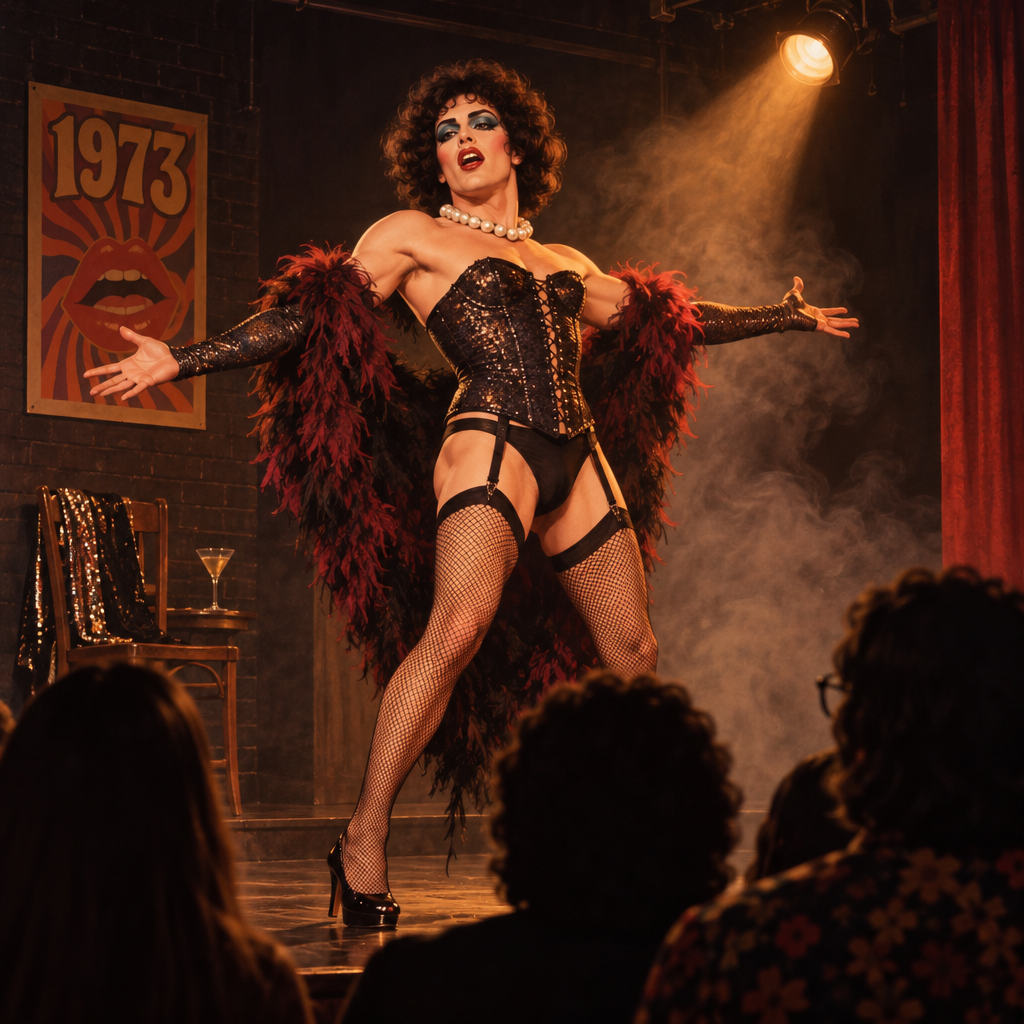
The Rocky Horror Show opened on 19 June 1973 at the Royal Court’s Theatre Upstairs, directed by Jim Sharman from O’Brien’s book, music and lyrics. Curry has said he found Frank-N-Furter’s voice on a London bus, overhearing a woman speak in clipped, upper-class tones and deciding the character should sound like the Queen rather than like an American rocker. That choice is the whole performance in miniature: aristocratic diction wrapped around a corset and fishnets.
Demand pushed the show down the King’s Road to a converted cinema, then to the King’s Road Theatre, where it ran for years. Producer Lou Adler saw it in London and brought it to his Roxy Theatre on the Sunset Strip in Los Angeles in March 1974, where it ran for nine months and became a hangout for the city’s rock scene. The Broadway transfer in March 1975 at the Belasco Theatre was a different story. It closed after 45 performances, and reviews treated the piece as a British oddity that had lost its intimacy in a proscenium house.
The film version, shot in England in late 1974 and released by 20th Century Fox in September 1975, initially looked like another failure. Fox pulled it from most theatres within weeks. The turnaround came in April 1976 at the Waverly Theater in Greenwich Village, New York, when midnight screenings started drawing a repeat crowd who shouted back at the screen, threw rice during the wedding scene and eventually dressed as the characters. That ritual spread across the United States and then the world, and the film has never left theatrical release. Fifty years on, it remains the longest-running theatrical release in cinema history.
For Curry, the role was both a gift and a cage. He has described declining to play Frank-N-Furter in the stage sequel and spending much of the late 1970s turning down parts that asked him to repeat the character. He also moved to New York, in part to put distance between himself and a Los Angeles that only wanted the man in the corset.
Broadway and the West End: Three Tony Nominations

The quickest way to correct the idea of Tim Curry as a camp specialist is to look at his stage record. Between 1975 and 2005 he worked with Tom Stoppard, Peter Shaffer, Mike Nichols and the Royal Shakespeare Company, and three of those jobs earned Tony nominations.
| Year | Production | Role | Venue | Recognition |
|---|---|---|---|---|
| 1975 | Travesties (Tom Stoppard) | Tristan Tzara | Ethel Barrymore Theatre, Broadway (from the RSC) | Play won the Tony for Best Play |
| 1980 to 1981 | Amadeus (Peter Shaffer) | Wolfgang Amadeus Mozart | Broadhurst Theatre, Broadway | Tony nomination, Best Actor in a Play |
| 1982 | The Pirates of Penzance | The Pirate King | Theatre Royal Drury Lane, London | West End transfer of the Joseph Papp staging |
| 1983 | The Rivals (Sheridan) | Bob Acres | National Theatre, London | Olivier-season classic revival |
| 1992 to 1993 | My Favorite Year | Alan Swann | Vivian Beaumont Theater, Lincoln Center | Tony nomination, Best Actor in a Musical |
| 2005 to 2006 | Monty Python’s Spamalot | King Arthur | Shubert Theatre, Broadway; then Palace Theatre, London | Tony nomination, Best Actor in a Musical; show won Best Musical |
Amadeus is the role theatre people still talk about. Curry played Mozart as a giggling, scatological prodigy opposite Ian McKellen’s Salieri, and the two of them turned Shaffer’s play into the hottest ticket on Broadway in the 1980 to 1981 season. McKellen took the Tony for Best Actor, but the production established Curry as a serious dramatic performer in New York, three years before Milos Forman’s film reached cinemas with different actors.
Spamalot bookended that reputation. Mike Nichols directed, Eric Idle wrote the book, and Curry’s King Arthur was the straight man holding together a stage full of killer rabbits and French taunters. His exasperated dignity drew on decades of experience in both farce and classical text. The show won the 2005 Tony for Best Musical and ran for more than 1,500 performances in New York, with Curry reprising Arthur when it opened at the Palace Theatre in London in 2006.
The Rock Star Detour
Between Rocky Horror and Amadeus, Curry made a genuine run at a music career. A&M Records released three albums: Read My Lips (1978), Fearless (1979) and Simplicity (1981). Fearless came closest to a hit, with “I Do the Rock,” a name-dropping new-wave single that namechecks everyone from Mick Jagger to Henry Kissinger, and “Paradise Garage,” a tribute to the New York club of the same name.
He toured behind the records with a full band and appeared on American television music shows, and the albums have a cult following among people who like their rock theatrical and literate. Commercially, they stalled. “I Do the Rock” reached the lower end of the Billboard Hot 100, and by 1981 Curry had concluded that the industry wanted a persona he was unwilling to supply. His later music would come through theatre and animation instead, where his baritone could serve a character rather than a brand.
1980s Films: Annie, Legend and Clue
Hollywood finally caught up with Curry’s range in a three-year stretch that produced two cult classics and one role under so much latex that you can barely see him.
Annie (1982). John Huston cast him as Rooster Hannigan, Miss Hannigan’s con-man brother, in Columbia’s lavish adaptation of the Broadway hit. His “Easy Street” number with Carol Burnett and Bernadette Peters is the film’s high point, a vaudeville strut that lets you see the stage performer in full flight. The picture was expensive and critics were lukewarm, but it has become a childhood staple for a generation that first met him there.
Legend (1985). Ridley Scott’s dark fairy tale needed a Lord of Darkness who could terrify and seduce in the same breath. Rob Bottin designed the makeup: enormous curved horns, cloven hooves, red skin and a bodybuilder’s torso, built up over several hours each day. Curry has described the application taking more than five hours and the removal, when he grew impatient and soaked it off himself, taking a layer of skin with it. What survives on screen is one of the great monster performances, all honeyed menace and wounded vanity, in a film that flopped in 1986 and found its audience on home video.
Clue (1985). Jonathan Lynn’s adaptation of the Parker Brothers board game cast Curry as Wadsworth the butler, racing through the mansion and reconstructing the murders in a breathless final monologue that is one of the most physically demanding comic sequences of the decade. Paramount released the film with three different endings sent to different cinemas, a gimmick that confused audiences and killed the box office. The ensemble included Madeline Kahn, Christopher Lloyd, Michael McKean, Eileen Brennan, Lesley Ann Warren and Martin Mull. Cable repeats and home video did the rest; by the 2000s the film was being quoted line for line at repertory screenings, and a new stage adaptation has toured North America.
The common thread across all three is pace. Curry speaks fast, moves fast and lands jokes on the offbeat, and directors learned to point a camera at him and let him go.
The 1990s: Pennywise, the Plaza Concierge and the Cardinal
If the 1980s made Curry a cult figure, the 1990s made him a household one, largely through supporting roles in films and television that tens of millions of people saw.
| Year | Title | Role | Director / Network | Why It Matters |
|---|---|---|---|---|
| 1990 | The Hunt for Red October | Dr. Yevgeni Petrov | John McTiernan, Paramount | Nervous ship’s doctor opposite Sean Connery; a rare restrained part |
| 1990 | Stephen King’s It (miniseries) | Pennywise the Dancing Clown | Tommy Lee Wallace, ABC | Two-night broadcast in November 1990; the definitive Pennywise for a generation |
| 1992 | FernGully: The Last Rainforest | Hexxus (voice) | Bill Kroyer, 20th Century Fox | Sings “Toxic Love,” a smoke-and-oil villain anthem |
| 1992 | Home Alone 2: Lost in New York | Mr. Hector, Plaza Hotel concierge | Chris Columbus, 20th Century Fox | The highest-grossing live-action film he has appeared in |
| 1993 | The Three Musketeers | Cardinal Richelieu | Stephen Herek, Disney | Scheming churchman opposite Charlie Sheen, Kiefer Sutherland and Chris O’Donnell |
| 1994 | The Shadow | Farley Claymore | Russell Mulcahy, Universal | Sweaty scientist villain in a pulp adaptation |
| 1995 | Congo | Herkermer Homolka | Frank Marshall, Paramount | Romanian treasure hunter in the Michael Crichton adaptation |
| 1996 | Muppet Treasure Island | Long John Silver | Brian Henson, Disney | Sings “Professional Pirate”; many critics call it the best human performance in a Muppet film |
| 1997 | McHale’s Navy | Major Vladakov | Bryan Spicer, Universal | Over-the-top terrorist in a flop remake |
Pennywise. When ABC adapted Stephen King’s 1,100-page novel into a two-part miniseries in November 1990, Curry insisted on minimal makeup after the ordeal of Legend. The result was a clown who looked almost ordinary, which is why he was so frightening: a painted face, a few prosthetic teeth and that voice sliding from carnival barker to snarl in a half-second. Bill Skarsgård’s 2017 and 2019 versions were more elaborate, and Skarsgård has spoken about the shadow Curry cast over the part. Roughly 30 million viewers watched the broadcast, and the storm-drain scene with young Georgie remains a reference point for television horror.
Home Alone 2. Mr. Hector has perhaps two dozen lines, and Curry makes every one count, from the slow, suspicious smile when Kevin checks in with his father’s credit card to the final chase through the Plaza lobby. Chris Columbus has said he cast Curry because he wanted a concierge who could be funny and faintly sinister at once, and the performance is now part of the annual Christmas television cycle. The film grossed more than $350 million worldwide.
Long John Silver. Brian Henson’s 1996 Muppet take on Treasure Island asked Curry to play the pirate straight, a trusted friend to young Jim Hawkins who turns out to be the villain, and he did it with real warmth. His scenes with Kermit’s Captain Smollett balance menace and affection in a way that has kept the film in rotation on Disney+ for years.
Television during the decade added an Emmy nomination for Outstanding Guest Actor in a Drama Series for Tales from the Crypt, where he played all three members of a grotesque farm family in the 1993 episode “Death of Some Salesmen,” and a memorable arc as record executive Winston Newquay on Wiseguy in 1989.
The Voice Behind the Cartoon Villains
For many people under 40, Tim Curry is first and foremost a voice. Beginning with Peter Pan and the Pirates on Fox in 1990, where his Captain Hook won a Daytime Emmy for Outstanding Performer in an Animated Program, he built one of the most extensive voice filmographies of any live-action star.
| Series or Film | Years | Character | Studio / Network |
|---|---|---|---|
| Peter Pan and the Pirates | 1990 to 1991 | Captain Hook | Fox Kids |
| Darkwing Duck | 1991 | Taurus Bulba | Disney |
| Gargoyles | 1994 to 1997 | Dr. Anton Sevarius | Disney |
| The Mask: Animated Series | 1995 to 1997 | Pretorius | CBS / New Line |
| Mighty Ducks | 1996 to 1997 | Lord Dragaunus | Disney |
| Beauty and the Beast: The Enchanted Christmas | 1997 | Forte the pipe organ | Disney |
| The Wild Thornberrys | 1998 to 2004 | Nigel Thornberry | Nickelodeon |
| Scooby-Doo and the Witch’s Ghost | 1999 | Ben Ravencroft | Warner Bros. |
| The Adventures of Jimmy Neutron | 2002 to 2006 | Professor Finbarr Calamitous | Nickelodeon |
| Star Wars: The Clone Wars | 2012 to 2014 | Chancellor Palpatine / Darth Sidious | Cartoon Network / Netflix |
Nigel Thornberry deserves special mention. The bumbling British wildlife documentarian with the enormous nose and the catchphrase “Smashing!” ran for five seasons and two feature films, and his face became an internet meme a decade later, which introduced Curry’s voice to people who had never seen Rocky Horror. He has said Nigel was based partly on the television naturalists he grew up with and partly on his own tendency toward enthusiasm.
The Palpatine casting is the most consequential. When Ian Abercrombie died in January 2012, Lucasfilm needed a new voice for the Chancellor in the final seasons of The Clone Wars. Curry took over in season five and continued through season six, delivering the quiet, grandfatherly menace the part requires. It is the only time he has stepped into a role in the Star Wars universe, and it coincided almost exactly with his stroke, so some of that work was recorded during his early recovery.
His audiobook career runs in parallel. He narrated several volumes of Lemony Snicket’s A Series of Unfortunate Events, including The Bad Beginning and The Reptile Room, work that earned a Grammy nomination for spoken word recording for children. In 2004 he also appeared on screen in the film adaptation’s world as a different kind of narrator, reading the audiobook of Ellen Potter’s Olivia Kidney and others. Video games extended the voice work further: he played Gabriel Knight in Sierra’s Gabriel Knight: Sins of the Fathers (1993), Arl Rendon Howe in BioWare’s Dragon Age: Origins (2009), Emperor Doviculus in Double Fine’s Brütal Legend (2009) and Premier Anatoly Cherdenko in Command & Conquer: Red Alert 3 (2008), whose line about escaping “to space” became one of gaming’s enduring clips.
Television Guest Spots in the 2000s
Curry worked steadily on American television through the first decade of the new century, often as a flamboyant one-off designed around his voice. On Psych in July 2007, he played Nigel St. Nigel, a savage reality-TV judge who was an unsubtle parody of Simon Cowell. On Will & Grace he appeared as a charming caterer, and on Monk he played a cruise-ship magician.
The darkest and most praised of these was Billy Flynn, “the Prince of Darkness,” a serial killer who terrorises Los Angeles during a rolling blackout in the Criminal Minds season five finale “Our Darkest Hour” and the season six premiere “The Longest Night” in 2010. Stripped of comedy, speaking slowly and barely moving, Curry showed how little he needed to frighten an audience. He also appeared as Professor Alexander Monro in John Landis’s black comedy Burke & Hare (2010) and in a parody of his own menace in Scary Movie 2 (2001), as the haunted-house professor.
Stroke, Recovery and Return
In July 2012 Curry suffered a major stroke at his home in Los Angeles. He kept the news private for nearly a year, and when he first appeared publicly again, at a Tony Awards viewing party in 2013, photographs showed him in a wheelchair. He has used one since, with limited movement on his left side, and has spoken frankly in interviews about speech therapy and the frustration of a career built on physical performance being reshaped overnight.
The Actors Fund gave him a Lifetime Achievement Award at its Tony Awards viewing party in June 2015, where he received a standing ovation and thanked the crowd in that unmistakable voice. His sense of humour had survived intact; asked by reporters how he was feeling, he said the stroke had left his wit untouched because it lived in a different part of his brain.
Fox brought him back to the role that started it all in October 2016, in The Rocky Horror Picture Show: Let’s Do the Time Warp Again, Kenny Ortega’s television remake starring Laverne Cox as Frank-N-Furter. Curry played the Criminologist, the narrator who sits at a desk and frames the story, a part originated by Charles Gray in 1975. He delivers his lines seated, as his condition required, and the casting gave the remake a continuity it badly needed. The broadcast drew about 4.9 million viewers in the United States.
Since then he has focused on voice roles, fan conventions and selected live-action parts. He appears in Stream, a 2024 horror film from the makers of the Terrifier series, alongside genre veterans Jeffrey Combs and Dee Wallace. He has become a fixture on the convention circuit, with signing lines at events across the United States and the United Kingdom that routinely stretch for hours. His memoir, Vagabond, arrived from Grand Central Publishing in October 2025, offering his own account of the Royal Court, the Roxy and the long shadow of Frank-N-Furter.
What Makes a Tim Curry Performance
Across half a century and more than 150 credits, you can trace a set of techniques that recur regardless of genre or budget.
The voice as instrument. Curry trained as a singer before he trained as an actor, and he treats dialogue the way a baritone treats a score. Listen to Wadsworth’s final monologue in Clue and you can hear him shifting tempo and key, slowing down for the reveal, accelerating through the reconstruction, dropping half an octave for a punchline. Pennywise does the same thing in reverse, moving from sing-song to growl. Casting directors in animation understood this before film directors did.
Aristocratic diction as menace. Starting with the bus-stop inspiration for Frank-N-Furter, Curry has used precise, upper-class English pronunciation to signal danger. Darkness in Legend, Cardinal Richelieu, Mr. Hector and Palpatine all speak in beautifully formed sentences while plotting something awful. The contrast between the manners and the intent is the joke and the threat at once.
Theatrical scale calibrated for the camera. The stock criticism of stage actors on film is that they play too big. Curry does play big, but he adjusts for the frame. In The Hunt for Red October, surrounded by Connery, Sam Neill and Scott Glenn, his Dr. Petrov is a small, sweating, worried man who never raises his voice. In Clue he fills the whole mansion. He chooses the size of the performance rather than defaulting to one.
Villains with appetite. His bad guys enjoy themselves. Hexxus sings about sludge with genuine erotic pleasure; Long John Silver loves the sea as much as the treasure; Rooster Hannigan is giddy at the thought of Easy Street. That appetite makes them watchable rather than merely hateful, and it is why children raised on his cartoons remember the villains more fondly than the heroes.
Generosity to co-stars. Carol Burnett, Madeline Kahn and Laverne Cox have all described working with him as a lesson in sharing a scene. The “Easy Street” number works because he hands the big moments to Burnett and takes his own in the gaps. Ensemble training in British repertory shows in these choices.
Where to Watch Tim Curry’s Best Work Now
Streaming rights shift constantly, so the table below lists each title’s current studio owner and its usual streaming home in the United States and United Kingdom. Where a title moves between services, a digital rental from Apple TV, Amazon or Google Play is almost always available for a few dollars or pounds.
| Title | Year | Studio Owner | Typical US Streaming Home | Typical UK Streaming Home |
|---|---|---|---|---|
| The Rocky Horror Picture Show | 1975 | 20th Century Studios (Disney) | Hulu | Disney+ |
| Annie | 1982 | Sony Pictures | Rotates (Netflix, Hulu); rental | Rotates; rental |
| Legend | 1985 | Universal | Peacock, or rental | Rental; occasional Prime Video |
| Clue | 1985 | Paramount | Paramount+ | Paramount+ |
| Stephen King’s It | 1990 | Warner Bros. | Max | Rental or Sky Store |
| The Hunt for Red October | 1990 | Paramount | Paramount+ | Paramount+ |
| Home Alone 2: Lost in New York | 1992 | 20th Century Studios (Disney) | Disney+ | Disney+ |
| FernGully: The Last Rainforest | 1992 | 20th Century Studios (Disney) | Disney+ | Disney+ |
| Muppet Treasure Island | 1996 | Disney | Disney+ | Disney+ |
| The Wild Thornberrys | 1998 to 2004 | Nickelodeon (Paramount) | Paramount+ | Paramount+ |
| Star Wars: The Clone Wars seasons 5 and 6 | 2012 to 2014 | Lucasfilm (Disney) | Disney+ | Disney+ |
| The Rocky Horror Picture Show: Let’s Do the Time Warp Again | 2016 | 20th Television (Disney) | Hulu, or rental | Disney+ |
Three practical notes. The Rocky Horror Picture Show is still best seen in a cinema with a shadow cast, and midnight screenings continue weekly in cities including New York, Los Angeles, London and Chicago. Clue has periodically left Paramount+ for other services, so check before you commit a movie night to it. His three A&M albums are on Spotify and Apple Music, which is the easiest way to hear “I Do the Rock” without hunting down vinyl.
Awards and Honours at a Glance
Curry has never won a Tony, an Oscar or a Primetime Emmy, a fact that says more about how the industry weighs genre and comedy than about the work. His recognised honours include:
- Daytime Emmy Award, Outstanding Performer in an Animated Program, for Peter Pan and the Pirates (1991)
- Tony Award nominations for Amadeus (1981), My Favorite Year (1993) and Spamalot (2005)
- Primetime Emmy nomination, Outstanding Guest Actor in a Drama Series, for Tales from the Crypt (1993)
- Grammy Award nomination for his Series of Unfortunate Events audiobook narration
- Actors Fund Lifetime Achievement Award (2015)
- Multiple Annie Award nominations for voice performance in animation
Why Tim Curry Still Matters
Pick any decade since 1973 and you will find a Tim Curry performance that a specific group of people considers formative. Rock fans and the LGBTQ community have Frank-N-Furter, a character who put gender play and sexual freedom into mainstream cinemas years before most studios would touch the subject. Children of the 1980s have Rooster and Wadsworth; children of the 1990s have Pennywise, Mr. Hector and Nigel Thornberry; gamers have Cherdenko and Arl Howe; Star Wars fans have his Palpatine.
That breadth is the legacy. Few actors have worked at the top level in rock musicals, Stoppard and Shaffer plays, Hollywood comedies, television horror, Saturday-morning cartoons, audiobooks and video games, and almost none have been the most memorable thing in each. Directors from Ridley Scott to Mike Nichols to Chris Columbus hired him because he could be trusted to make a supporting role unforgettable without unbalancing the picture.
The fandom reflects it. Convention lines for his autograph include people in Frank-N-Furter corsets, parents holding Wild Thornberrys DVDs and teenagers who know him only from Red Alert memes, all waiting for the same man. When a stroke took away much of his physical range, the voice remained, and the voice turned out to be enough. Half a century after a three-week run above a Chelsea theatre, Tim Curry is still the reason millions of people first understood that a villain could be the most fun person in the room.
FAQ
How old is Tim Curry and where was he born?
Tim Curry was born on 19 April 1946 in Grappenhall, a village near Warrington in Cheshire, England. He turned 79 in April 2025. He has lived primarily in Los Angeles for decades, after earlier years in London and New York.
What is Tim Curry’s most famous role?
Dr. Frank-N-Furter in The Rocky Horror Picture Show (1975) remains his signature part, the one he originated on stage in London in 1973 and played in Los Angeles and on Broadway. Pennywise in the 1990 miniseries It, Wadsworth in Clue and the concierge in Home Alone 2 are the roles most often cited after it.
Did Tim Curry win a Tony Award?
No. He was nominated three times, for Amadeus in 1981, My Favorite Year in 1993 and Spamalot in 2005, but did not win. His only major competitive award is a Daytime Emmy for voicing Captain Hook in Peter Pan and the Pirates in 1991.
What happened to Tim Curry’s health?
He suffered a major stroke in July 2012 that affected his mobility, and he has used a wheelchair since. His speech and voice recovered well enough for him to continue voice acting, make convention appearances and return to Rocky Horror as the Criminologist in Fox’s 2016 television remake.
Is Tim Curry still acting?
Yes, though selectively. His recent credits include voice work, convention panels and the 2024 horror film Stream, and he published a memoir, Vagabond, in October 2025. He has not taken a leading live-action role since his stroke.
Where can I watch The Rocky Horror Picture Show?
In the United States it streams on Hulu; in the United Kingdom it is on Disney+. Both reflect Disney’s ownership of the 20th Century Fox catalogue. The film also remains in continuous theatrical release, with weekly midnight screenings in major cities, which is the way most fans recommend seeing it for the first time.