The most disturbing scary movie ever made is Martyrs (2008), and the best one for most viewers is Hereditary (2018), which sits at No. 2 on our list. This ranking measures how long a film stays with you after the credits, using four factors that are explained below, and it notes where to watch each pick.
Key Takeaways
– No. 1 is Martyrs (2008), Pascal Laugier’s French film. It is the hardest watch on the list and is not a starter horror movie.
– No. 2 is Hereditary (2018), the best mix of fear and craft for a general audience, anchored by Toni Collette.
– “Scary” and “disturbing” are different things. Jump scares raise your pulse for a few seconds. Disturbing films change your mood for days.
– Two non-horror films beat most horror films for sheer damage: Come and See (1985) and Threads (1984). Threads made the ranked list.
– Streaming homes follow the studio. Warner titles sit on HBO Max, Paramount titles on Paramount+, Universal and Blumhouse titles on Peacock, and the extreme international films mostly live on Shudder.
How We Ranked These Scary Movies
Most lists of the scariest movies of all time mix two separate experiences. One is the spike, the moment a figure appears in a doorway and your shoulders hit your ears. The other is the residue, the feeling that keeps you from turning off the hallway light a week later. This list ranks the residue.
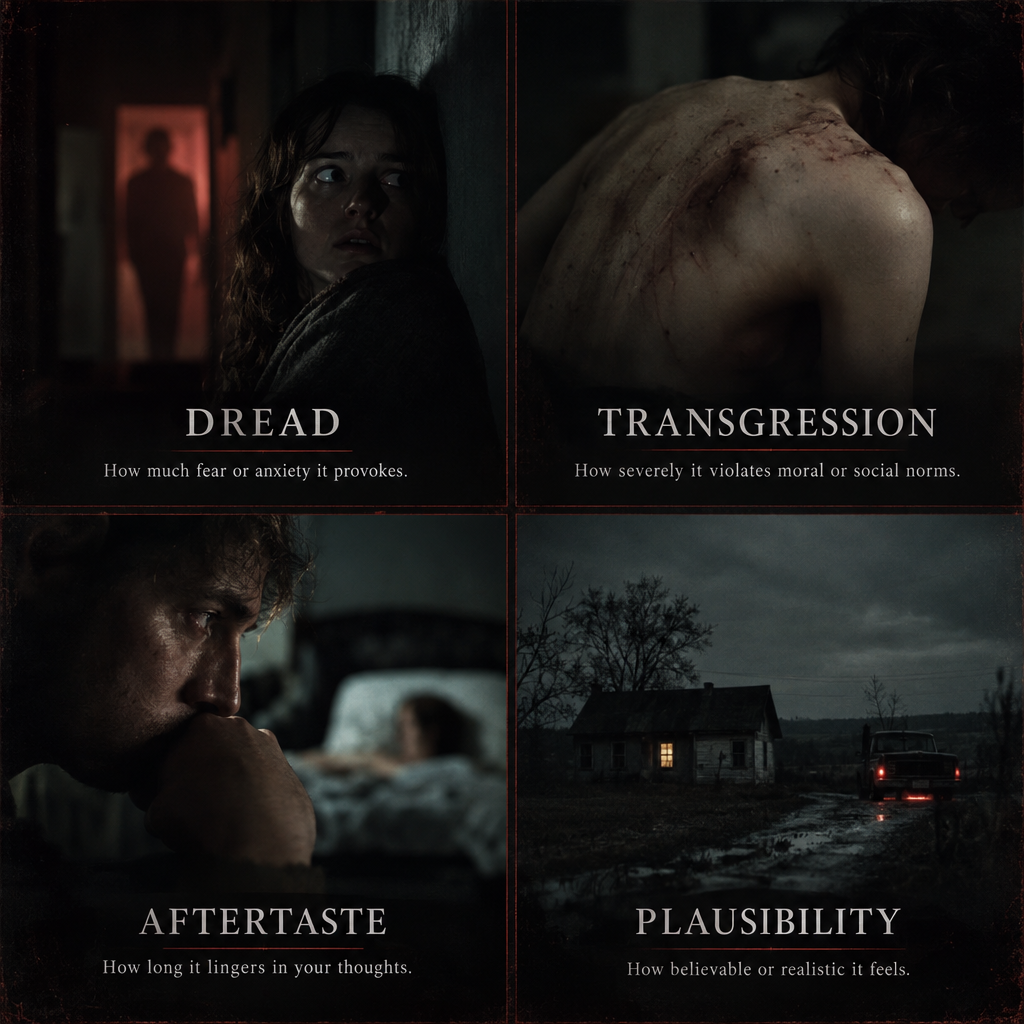
Each film was scored on four factors:
| Factor | What it measures | Film that maxes it out |
|---|---|---|
| Dread | Sustained tension, how long the film makes you wait for the bad thing | Lake Mungo |
| Transgression | How far it breaks taboos you assumed movies respected | Martyrs |
| Aftertaste | How long it lingers after the credits | Threads |
| Plausibility | How easily the horror could happen in reality | Speak No Evil |
A film can be terrifying in the moment and still land low here. The Conjuring is a brilliantly engineered fright machine, but most people sleep fine afterward because Ed and Lorraine Warren win and the family survives. A film like The Vanishing contains almost no on-screen violence and lands near the top, because its final ten minutes reshape how you see the rest of the movie and, for some viewers, the world.
Why heart rate isn’t the whole story
In 2020, the UK site Broadband Choices ran a widely shared “Science of Scare” study that tracked viewers’ heart rates during dozens of horror films. Sinister (2012) came out on top, with Insidious and The Conjuring close behind. The study is fun, but it measures startle, and startle fades quickly. Nobody’s pulse spikes during Threads. Thousands of British viewers in 1984 still said they could not sleep after it aired on the BBC. Your body’s alarm system and your sense of dread run on separate tracks, and the best scary movies reach both.
The Ranking: 25 to 1
Streaming deals rotate monthly. The platforms below reflect where each film is usually found, based on which studio owns it. Every major title here can also be rented or bought on Apple TV, Prime Video, Google Play, or Fandango at Home if your subscription lineup comes up short.
25. Paranormal Activity (2007)
Oren Peli made it for about $15,000 in his own San Diego house, and it went on to gross nearly $200 million for Paramount. That money traces back to a simple idea: you watch the timestamp in the corner of a static bedroom shot and wait for the door to move. The scares are clever, but the domestic setting is what makes it rank. Your own bedroom is the scene of the crime, and the “found footage” format makes it feel like a home video a friend sent you. It sits at the bottom because the dread mostly ends when the film does. Paramount owns it, so it streams on Paramount+.
24. The Conjuring (2013)
James Wan’s haunted-house film, “inspired by” the Warrens’ case files on the Perron family in Harrisville, Rhode Island, is the most efficient fright delivery system of the last twenty years. The hide-and-clap game in the basement is one of the best-staged scares of the century. Patrick Wilson and Vera Farmiga play the Warrens with such warmth that the film reassures you as much as it frightens you, which is why it lands low on a disturbance scale. It is a Warner Bros. title, so it lives on HBO Max with the rest of the Conjuring universe.
23. Sinister (2012)
Ethan Hawke plays Ellison Oswalt, a fading true crime writer who moves his family into a house where a murder took place and finds a box of Super 8 reels in the attic. The heart-rate study crowned it the scariest film for good reason: the “Lawn Work” reel is a pure nerve attack. Scott Derrickson’s film earns its spot through the reels themselves, which are grainy, sun-bleached, and deeply wrong, more than through its demon, Bughuul. Rent it digitally on any major store, since its streaming home changes often.
22. Alien (1979)
Ridley Scott’s film is sci-fi horror at its most elegant. The chestburster scene still works because the cast reportedly did not know exactly how much blood was coming. H.R. Giger’s creature design is openly sexual and bodily, and the film’s real subject is violation: the crew of the Nostromo is used as raw material by a company that considers them expendable. Sigourney Weaver’s Ripley is the reason you keep watching. It is a 20th Century Studios title, so check Hulu first.
21. Get Out (2017)
Jordan Peele won the Oscar for Best Original Screenplay for a film that works as a thriller, a satire, and a nightmare all at once. Daniel Kaluuya’s Chris visits his white girlfriend’s family upstate, and the polite small talk curdles into something far worse. The Sunken Place gave the culture a new phrase for a real kind of powerlessness, and that grounding in reality is what lifts it above the haunted-house crowd. It is a Universal and Blumhouse release, which means Peacock is its most common streaming home.
20. The Thing (1982)
John Carpenter’s remake flopped in the summer of E.T., then spent four decades being recognized as a masterpiece. Rob Bottin’s practical effects, with heads sprouting spider legs and chests opening into jaws, remain shocking, but the paranoia is what lingers. At an Antarctic research station, Kurt Russell’s MacReady cannot know which of his colleagues is still human, and the blood-test scene ranks as one of the tensest sequences in film. Universal owns it, so look on Peacock, and it rents everywhere.
19. The Babadook (2014)
Jennifer Kent’s debut follows Amelia (Essie Davis), a widowed mother whose exhaustion and buried grief take the shape of a creature from a pop-up book. The monster is effective, but the truly frightening scenes show a mother losing patience with her screaming son, Samuel (Noah Wiseman), in ways any exhausted parent will recognize with a jolt of shame. It is a horror film about depression that refuses an easy cure. IFC Midnight released it in the US, and it has typically streamed on Shudder, which shares a parent company with IFC.
18. The Witch (2015)
Robert Eggers built his debut from 17th-century diaries and court records, and the dialogue sounds like it. A Puritan family is banished to the edge of a New England forest in the 1630s, their baby vanishes, and suspicion falls on the eldest daughter, Thomasin (Anya Taylor-Joy, in her breakout role). The film takes religious terror seriously, treating the devil as a real presence in the woods rather than a metaphor, and Black Phillip the goat became a horror icon. It is an A24 catalog title, so it rotates through HBO Max and rents everywhere.
17. Rosemary’s Baby (1968)
Roman Polanski’s film is the great New York horror movie. The fictional Bramford is played by the Dakota on Central Park West, and the menace comes from the nosy neighbors down the hall. Mia Farrow’s Rosemary is pregnant, isolated, and slowly realizing that everyone around her, including her husband (John Cassavetes), has made a deal with the devil. Ruth Gordon won an Oscar as the meddling Minnie Castevet. What disturbs is the film’s view of bodily autonomy, and it has aged into something sharper than it was in 1968. Paramount owns it, so it streams on Paramount+, and the Criterion edition is worth buying.
16. Ringu (1998)
Hideo Nakata’s adaptation of Koji Suzuki’s novel turned a cursed VHS tape into a global fear and launched the J-horror wave that Hollywood copied with The Ring in 2002. The tape’s footage is genuinely uncanny, and the final scene, with Sadako crawling out of a television full of static, is one of the most influential images in horror. It ranks this high because of its logic: the only way to survive is to pass the curse on to someone else. Arrow Video’s 4K restoration is the version to seek out on disc, and digital rental is the easiest route.
15. The Shining (1980)
Stanley Kubrick’s take on Stephen King is less a haunted-hotel movie than a portrait of a father becoming dangerous in front of his family. Jack Nicholson gets the famous lines, but Shelley Duvall’s terror feels real, and Danny Lloyd’s tricycle rides through the Overlook’s hallways are hypnotic. The film’s ambiguity has fueled endless theories, which Rodney Ascher’s documentary Room 237 (2012) explores with obsessive delight. It is a Warner Bros. title, so it streams on HBO Max.
14. Pulse (2001)
Kiyoshi Kurosawa’s Kairo imagines ghosts arriving through the internet, a dial-up signal that drains people of the will to live and leaves only dark smudges on walls. It looked dated for about ten years. Now, in the era of doomscrolling and the loneliness of a feed, it looks prophetic. The ghosts move in a slow, stuttering way that is hard to shake, and the film’s vision of Tokyo slowly emptying out is one of the bleakest endings in J-horror. Track it down on disc or digital rental, and keep an eye out for Kurosawa retrospectives at New York repertory houses.
13. Lake Mungo (2008)
Joel Anderson’s Australian faux documentary follows the Palmer family after their teenage daughter, Alice, drowns at a local dam. It is presented as a sober TV-style investigation, with interviews, home video, and photographs, and it contains perhaps three moments that qualify as scares. Those three moments are devastating, and the film around them is a quiet study of grief that leaves you hollowed out. It scores the highest on dread of any film here, and Shudder has been its most reliable streaming home.
12. Skinamarink (2022)
Kyle Edward Ball shot this experimental film for about $15,000 in his childhood home in Edmonton. Two small children wake in the night to find their father gone and the doors and windows of their house disappearing. Most of the running time is grainy shots of ceilings, hallways, and a TV playing old public-domain cartoons. Plenty of viewers find it boring. For the people it reaches, it taps a pre-verbal childhood fear more directly than anything else in horror. Shudder acquired it, and it streams there.
11. The Exorcist (1973)
William Friedkin’s film was the first horror movie nominated for Best Picture. Theaters reported fainting and vomiting in the lines that stretched around city blocks that winter. Linda Blair’s Regan is the shock, but the film’s true subject is a mother (Ellen Burstyn) watching medicine fail her child, and a priest (Jason Miller) who has lost his faith. The spinal tap and arteriography scenes still make audiences squirm more than the pea soup does. It is a Warner Bros. title on HBO Max.
10. The Texas Chain Saw Massacre (1974)
Tobe Hooper shot it in brutal Texas summer heat with a tiny budget and a cast that was genuinely miserable, and that misery bleeds through every frame. It was loosely inspired by Ed Gein and opened with narration claiming the events were true, a lie that worked on a lot of people. There is far less gore than its reputation suggests, but the dinner scene, with Marilyn Burns screaming for what feels like an eternity, is the closest any film has come to the feeling of a fever dream. Streaming rights rotate among free and paid services, and Dark Sky Films’ 4K restoration is the version to own.
9. Possession (1981)
Andrzej Żuławski’s Berlin-set film begins as a divorce drama between Isabelle Adjani and Sam Neill and becomes something unclassifiable, involving doppelgängers, a tentacled creature, and the most famous breakdown in screen history, which Adjani performs alone in a subway underpass. She won Best Actress at Cannes for it. The film was cut to pieces for its US release and turned up on Britain’s “video nasties” list. Metrograph Pictures’ 2023 restoration finally gave it a proper American life on screens and disc. Rent it digitally and keep an eye on Metrograph’s Lower East Side calendar.
8. Noroi: The Curse (2005)
Kōji Shiraishi’s Japanese found-footage film is assembled as the last documentary of a paranormal researcher named Masafumi Kobayashi, who has since vanished. It strings together TV variety show clips, interviews, and seemingly random incidents that slowly connect into something ancient and malevolent. The slow accumulation is the point: at about the hour mark, you realize every throwaway detail mattered. Nothing in Western found footage comes close to its sense of creeping, cosmic wrongness. It streams on Shudder.
7. Funny Games (1997)
Michael Haneke’s Austrian film follows two polite young men in white gloves who take a family hostage at their lake house. Haneke made it as an attack on audiences who enjoy screen violence, and he breaks the fourth wall to make you complicit. In one scene, a character literally rewinds the movie when things go the wrong way for the killers. It is cold, cruel, and intentionally unrewarding. Haneke remade it shot-for-shot in English in 2007 with Naomi Watts, Tim Roth, and Michael Pitt, and that version is easier to find for digital rental. The original is better.
6. Audition (1999)
Takashi Miike’s film spends its first hour as a gentle, almost sad romantic drama about a widower (Ryo Ishibashi) who stages fake film auditions to find a new wife and becomes fixated on the quiet Asami (Eihi Shiina). Then it turns. The final act is notorious, and the phrase “kiri kiri kiri” haunts anyone who has seen it. The slow bait-and-switch is crueler than the violence itself because you have been lulled into trusting the movie. Arrow Video’s restoration is the version to seek out, and it rents digitally.
5. The Vanishing (1988)
George Sluizer’s Dutch-French film opens with a young couple, Rex and Saskia, on a road trip. At a crowded gas station, Saskia goes inside to buy drinks and never comes back. The film then tells you who took her within its first half, and the horror comes from Rex’s years-long obsession with learning what happened. Stanley Kubrick reportedly told Sluizer it was the most terrifying film he had ever seen. The ending is a cold, perfect shock that we will not spoil. Do not mix it up with Sluizer’s own 1993 Hollywood remake starring Jeff Bridges. The original is available from the Criterion Collection.
4. Speak No Evil (2022)
Christian Tafdrup’s Danish film follows a mild-mannered family that accepts a weekend invitation from a Dutch couple they met on vacation in Tuscany. Every red flag is the kind you ignore to avoid being rude, and the film builds to an ending so bleak that viewers still argue about whether it is a fair one. It ranks this high on plausibility: it is about how social politeness can be weaponized. Blumhouse remade it in 2024 with James McAvoy and a much softer ending. The original is a Shudder release, and the remake is a Universal title that turns up on Peacock.
3. Threads (1984)
The BBC aired Mick Jackson’s film about a nuclear attack on Sheffield, written by Barry Hines (the author behind Kes). It is not technically a horror film, and it is more frightening than almost every horror film ever made. It follows two ordinary families from the news reports through the strike and into the decade that follows, with on-screen text giving casualty figures in the dry tone of a government report. The final scene is one of the most shattering images in British TV history. Severin Films issued a restored Blu-ray in 2018, which remains the best way to see it.
2. Hereditary (2018)
Ari Aster’s debut became A24’s biggest worldwide hit until Everything Everywhere All at Once, and it earned that success. Toni Collette’s Annie, a miniature artist grieving her secretive mother, delivers a performance of raw, ugly anguish that the Oscars inexplicably ignored. The film’s first great shock comes early and is so sudden and so final that it rewires how you watch everything after it. It is a family tragedy first and a supernatural horror film second, and that order is why it devastates. As an A24 title, it rotates between HBO Max and other services, and it rents on every major store.
1. Martyrs (2008)
Pascal Laugier’s film is the high-water mark of the New French Extremity movement and the most disturbing horror film we have seen. It begins with a revenge story, as Lucie (Mylène Jampanoï) hunts down the family she believes imprisoned her as a child, and then becomes something else entirely in its second half. That half is long, clinical, and centered on the methodical suffering of Anna (Morjana Alaoui). The film is not gratuitous for its own sake. It asks a real philosophical question about suffering and transcendence, and its final line has kept people arguing for nearly two decades. That seriousness is exactly why it hurts more than any slasher. It is not a film to watch casually, with a date, or alone after a bad week. Shudder has been its most consistent streaming home. Skip the 2015 American remake.
The Non-Horror Film That Beats All of Them
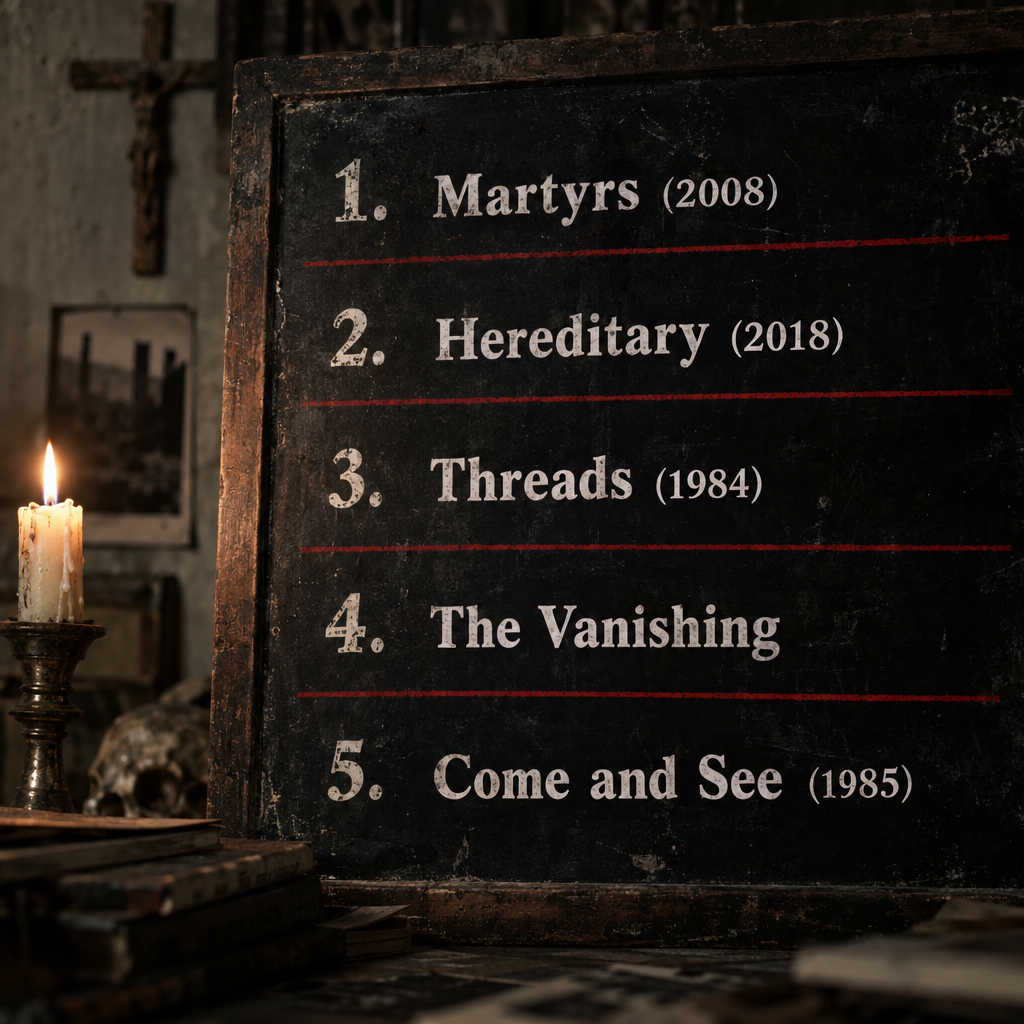
One film did not make the ranked list because it is a war film, not horror. Elem Klimov’s Come and See (1985) follows a teenage Belarusian boy who joins the partisans during the Nazi occupation, and his face visibly ages over the course of the film. The final act, which depicts the burning of a village, is the most harrowing sequence in cinema. If the four-factor scale applied, it would beat Martyrs. The Criterion Collection released Janus Films’ restoration in 2021, and it streams on the Criterion Channel.
Scary Movies by Subgenre
Ranked lists are useful, but most nights you want a specific flavor. These picks run from mild to rough within each category.
Psychological horror movies
Psychological horror lives in the gap between what the character perceives and what is real. Start with Misery (1990), which proves that a Rob Reiner director credit can mean This Is Spinal Tap or Kathy Bates in an Oscar-winning turn with a sledgehammer. Then move to Roman Polanski’s Repulsion (1965), Adrian Lyne’s Jacob’s Ladder (1990), Kiyoshi Kurosawa’s serial-killer procedural Cure (1997), and Darren Aronofsky’s Black Swan (2010). Cure is the most underseen film on this list, and Koji Yakusho’s detective is the perfect audience surrogate for its creeping horror.
Sci-fi horror movies
The best sci-fi horror uses technology or space to isolate people and then turn their bodies against them. Beyond Alien and The Thing, watch David Cronenberg’s The Fly (1986) and Videodrome (1983), the second of which predicted our relationship with screens with uncomfortable accuracy. Paul W.S. Anderson’s Event Horizon (1997) was a flop that became a cult object, and Alex Garland’s Annihilation (2018) has a bear scene that still makes audiences gasp. Jonathan Glazer’s Under the Skin (2013), with Scarlett Johansson, is the most unnerving of the group.
Slasher horror movies
Bob Clark’s Black Christmas (1974) invented most of the slasher rules four years before John Carpenter’s Halloween (1978) perfected them. Wes Craven gave the genre a dream-logic villain with A Nightmare on Elm Street (1984) and then dissected it with Scream (1996). Prom Night (1980) gave Jamie Lee Curtis a second scream-queen showcase, and Brian De Palma’s Carrie (1976) owns the most famous prom in horror, even though it is more tragedy than slasher. For something newer, Netflix’s Fear Street trilogy (2021) is a loving throwback, and Part Two: 1978 is the strongest, with Sadie Sink giving the summer-camp entry real emotional weight. Terrifier 2 (2022) is the extreme end, recommended only for gorehounds.
Horror comedy movies
Horror comedy is the best on-ramp for anyone who claims they do not like scary movies. Evil Dead II (1987), Shaun of the Dead (2004), Tucker & Dale vs. Evil (2010), The Cabin in the Woods (2012), and What We Do in the Shadows (2014) are the five essentials. Tim Curry belongs to this lineage twice: once as Frank-N-Furter in The Rocky Horror Picture Show (1975), a midnight-movie staple for fifty years, and once as Pennywise in the 1990 It miniseries, which is half camp and half childhood trauma for a generation. The Wayans brothers’ Scary Movie franchise spoofs everything on this page, and the 2000 original is the best of the five. Paramount has a sixth film on its 2026 slate with Anna Faris and Regina Hall returning.
Blumhouse horror movies
Jason Blum’s company built an empire on low budgets and high concepts, and its logo now signals a specific kind of studio horror. The highlights include Paranormal Activity (2007), Insidious (2010), Sinister (2012), Get Out (2017), Leigh Whannell’s The Invisible Man (2020), with Elisabeth Moss facing an abuser no one else can see, and The Black Phone (2021), with Ethan Hawke as a masked kidnapper. Blumhouse’s deal with Universal means most of its recent output lands on Peacock, including M3GAN (2022) and Five Nights at Freddy’s (2023), which debuted on Peacock the same day it opened in theaters.
True crime and haunting documentaries
Some of the scariest films are real. Cropsey (2009), by Joshua Zeman and Barbara Brancaccio, investigates a Staten Island urban legend about a boogeyman and the actual child disappearances that became tied to the grounds of the abandoned Willowbrook State School. It is the most chilling movie made about New York City’s outer boroughs. Bart Layton’s The Imposter (2012) tells a true story so strange it plays like a thriller. Rodney Ascher’s The Nightmare (2015) dramatizes sleep paralysis with first-person accounts and, for some viewers, can bring on the condition. George Ratliff’s Hell House (2001) follows a Texas church as it stages a haunted house meant to scare teenagers into faith, and it is unsettling for reasons the church never intended.
Where to Stream Scary Movies Right Now
Horror rights follow the studio far more reliably than any single “best of” list. Here is how the major services break down for horror fans:
- HBO Max: Warner Bros.’ horror catalog, including The Exorcist, The Shining, the Conjuring universe, and Andy Muschietti’s It films, plus a rotating set of A24 titles.
- Paramount+: The most underrated horror library of the big services, with Rosemary’s Baby, the Paranormal Activity series, Event Horizon, A Quiet Place (2018), Annihilation, and Smile (2022). Paramount+ is also the place to watch the Paramount-backed Scary Movie franchise.
- Peacock: Universal’s classic monsters, Jordan Peele’s films, and most of Blumhouse’s recent output. Its October lineup reliably pushes these haunting titles to the front.
- Shudder: The essential service for anyone who has worked through the mainstream canon. Skinamarink, Speak No Evil, Noroi, Lake Mungo, Rob Savage’s Zoom-call chiller Host (2020), and much of the extreme international material on this list live here.
- Hulu: 20th Century and Neon titles, including Alien and Osgood Perkins’s Longlegs (2024).
- Netflix: Strong originals like Mike Flanagan’s Gerald’s Game (2017), the Fear Street trilogy, and Flanagan’s series The Haunting of Hill House, which is among the best horror shows ever made for streaming.
- The Criterion Channel: The Vanishing, Come and See, and the art-house end of horror.
Before you cancel a subscription in a fit of October budgeting, check a tracking service to see where a title currently streams, because these deals turn over constantly.
How to Build a Horror Night Without Ruining Anyone’s Week
The most common mistake is putting Martyrs or Audition on for a group that has only seen Scream. Disturbing films need consent from the room. A good escalation for a mixed group starts with a horror comedy, moves to a crowd-pleasing scare machine like The Conjuring or Get Out, and ends with something like Hereditary or The Witch for the people who are still awake.
Viewing order matters for a solo deep dive, too. If you are working toward the top of this list, watch Funny Games before Speak No Evil, since the Danish film is in conversation with Haneke’s. Watch Ringu before Pulse to see how Japanese horror moved from cursed tapes to cursed networks.
Then there’s the setting. Horror plays differently with an audience, and New York still has some of the best rooms in the country for it. Nitehawk Cinema’s midnight series in Williamsburg, Film Forum’s repertory runs, Metrograph’s restorations, and the small and deeply strange programming at Spectacle Theater have all given these films the screenings they deserve. Seeing The Texas Chain Saw Massacre at midnight with a full house is a different film than watching it on a laptop at noon.
The 15 Runners-Up
These films narrowly missed the 25 and round out a list of 40:
- Night of the Living Dead (1968)
- Don’t Look Now (1973)
- The Wicker Man (1973)
- Black Christmas (1974)
- Halloween (1978)
- Cure (1997)
- The Blair Witch Project (1999)
- Session 9 (2001)
- The Descent (2005)
- [REC] (2007)
- Insidious (2010)
- It Follows (2014)
- Smile (2022)
- Talk to Me (2023)
- Longlegs (2024)
Night of the Living Dead entered the public domain because of a copyright notice error, so George A. Romero’s landmark is legally free to stream on several services. The Descent has the strongest claustrophobia of any film here, and the Philippou brothers’ Talk to Me is the best horror debut of the 2020s so far.
FAQ
What is the top 10 scariest movie?
By our disturbance ranking, the top 10 are Martyrs (2008), Hereditary (2018), Threads (1984), Speak No Evil (2022), The Vanishing (1988), Audition (1999), Funny Games (1997), Noroi: The Curse (2005), Possession (1981), and The Texas Chain Saw Massacre (1974). If you want the scariest in terms of jump-in-your-seat fright rather than lingering damage, swap in Sinister, The Conjuring, Insidious, Paranormal Activity, and The Exorcist.
What’s the best scary movie 1, 2, 3, 4, 5?
If you mean a five-film starter pack, watch Halloween (1978), The Exorcist (1973), The Shining (1980), The Conjuring (2013), and Hereditary (2018), in that order, which gives you the history of modern horror in one week. If you mean the five Scary Movie spoofs, the 2000 original is the best by a wide margin, the second film is uneven, and the third, fourth, and fifth largely trade the Wayans’ edge for celebrity cameos.
What is a 10/10 scary movie?
A 10/10 scary movie maxes out all four factors: it builds dread, breaks a taboo, lingers for days, and feels like it could happen. Hereditary is the closest any widely released film comes to that score, since it delivers sustained tension, a genuinely shocking turn, a family tragedy that feels real, and an ending people still talk about. Martyrs scores higher on transgression but is too extreme for a general audience to call a perfect scary movie.
What are the 40 scariest movies of all time?
The 25 ranked films above plus the 15 runners-up make our list of 40. Together they cover found footage, J-horror, slashers, folk horror, sci-fi horror, and the New French Extremity, from Night of the Living Dead in 1968 to Longlegs in 2024.
What is the difference between a scary movie and a disturbing one?
A scary movie targets your startle reflex with sudden noises, sudden images, and the release that follows. A disturbing movie targets your assumptions about people, families, and safety, and its effect builds over time. Paranormal Activity is scary. The Vanishing is disturbing. The best horror films, like The Exorcist and Hereditary, manage both.
What is a good disturbing movie for someone new to horror?
Start with Get Out or The Babadook. Both are deeply unsettling and grounded in real-world fears (racism and grief), but neither relies on extreme violence. If those land well, move up to The Witch, then Hereditary, and save anything in our top 10 until you know your limits.